Transparency & Trust: an Experimental Study of Online Disclosure

Washington-20130820-00261


A big thank you to Stephan Grimmelikhuijsen for sending me two copies of his book overseas: Transparency and trust: an experimental study of online disclosure and trust in government. You can download a version of it (dissertation) here.

Stephan’s work is, in my opinion, extremely important reading for those working in the field of transparency and accountability.

As it turns out, whether we like it or not, claims that transparency leads to more trust are not supported by the existing evidence. Still not convinced? Read a short review of the evidence here.

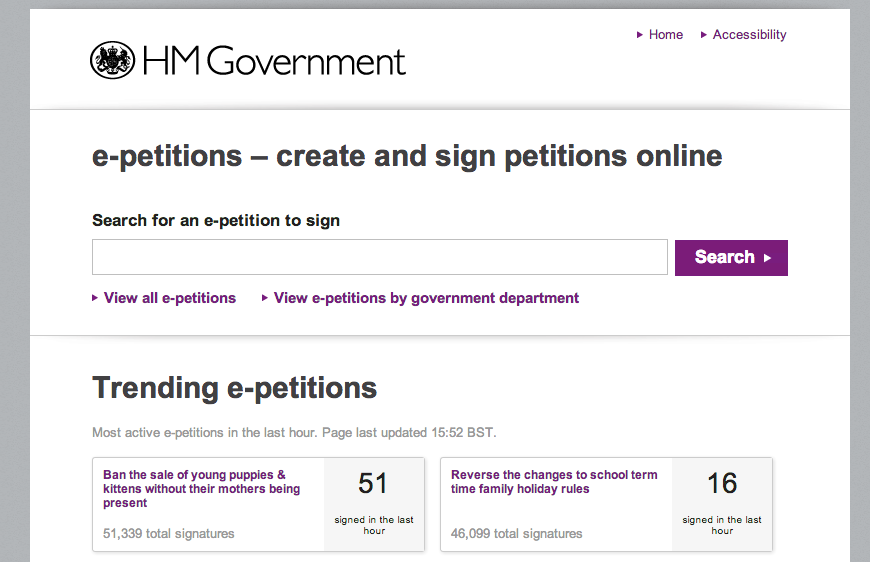
Modeling the Rise in Internet-based Petitions

Screen Shot 2013-08-10 at 10.59.56 AM

By Taha Yasseri, Scott A. Hale, and Helen Margetts (Oxford Internet Institute)

Collective action taking place on Internet platforms leaves a digital imprint which may be harvested to better understand the dynamics of mobilization. This ‘big data’ offers social science researchers the potential for new forms of analysis, using real-time transactional data based on entire populations, rather than sample-based surveys of what people think they did or might do. This paper uses a big data approach to track the growth of about 20,000 petitions to the UK Government over two years, analyzing the rate of growth and the outreach mechanism. The number of signatures was collected for all petitions with an hourly resolution. The vast majority of petitions did not achieve any measure of success; over 99 percent failed to get the 10,000 signatures required for an official response, and only 0.1 percent attained the 100,000 required for a parliamentary debate. We analyze the data through a multiplicative process model framework to explain the growth of signatures. We have defined and measured an average outreach factor for petitions and show that it decays very fast (reducing to 0.1% after 10 hours); after 24 hours, a petition’s fate is virtually set.

Read the full paper here [PDF].

And if you are interested in e-petitions, you may also like this. 

Italian Politics 2.0: The Multifaceted Effect of the Internet on Political Participation

We investigate the impact of the diffusion of high-speed Internet on different forms of political participation, using data from Italy. We exploit differences in the availability of ADSL broadband technology across municipalities, using the exogenous variation induced by the fact that the cost of providing ADSL-based Internet services in a given municipality depends on its relative position in the pre-existing voice telecommunications infrastructure. We first show that broadband Internet had a substantial negative effect on turnout in parliamentary elections between 1996 and 2008. However, we also find that it was positively associated with other forms of political participation, both online and offline: the emergence of local online grassroots protest movements, and turnout in national referenda (largely opposed by mainstream parties). We then show that the negative effect of Internet on turnout in parliamentary elections is essentially reversed after 2008, when the local grassroots movements coalesce into the Five-Star Movement (M5S) electoral list. Our findings are consistent with the view that: 1) The effect of Internet availability on political participation changes across different forms of engagement; 2) It also changes over time, as new political actors emerge who can take advantage of the new technology to tap into the existence of a disenchanted or demobilized contingent of voters; and 3) These new forms of mobilization eventually feed back into the mainstream electoral process, converting “exit” back into “voice”.

Read full paper here [PDF].

Mobile Connectivity in Africa: Increasing the Likelihood of Violence?

Regarding the above picture of DRC government troops with their mobile phones, Alexis Madrigal from the Atlatinc wrote in his column last year:

I don’t know what to say about this photograph aside from suggesting that an enterprising PhD student write a dissertation on “Cell Phones in War.” How are fighting, killing, and controlling territory different when you can call your brother after battle, post a photo of your squadron on the march to Facebook, or play Angry Birds between skirmishes?

Part of the answer to Alexis’ question comes in a newly published article in the American Political Science Review by postdoctoral fellow Jan Pierskalla and PhD candidate Florian Hollenbach (ht the Monkey Cage).

In a nutshell, the authors’ findings suggest that cell phone coverage in Africa increases the likelihood of political violence. The abstract is below:

The spread of cell phone technology across Africa has transforming effects on the economic and political sphere of the continent. In this paper, we investigate the impact of cell phone technology on violent collective action. We contend that the availability of cell phones as a communication technology allows political groups to overcome collective action problems more easily and improve in-group cooperation, and coordination. Utilizing novel, spatially disaggregated data on cell phone coverage and the location of organized violent events in Africa, we are able to show that the availability of cell phone coverage significantly and substantially increases the probability of violent conflict. Our findings hold across numerous different model specifications and robustness checks, including cross-sectional models, instrumental variable techniques, and panel data methods.

It will be interesting to see how this paper resonates with different audiences, such as the ICT4D community and political scientists. Some have already started to question the methodology and underlying assumptions in the paper.

But despite the findings of this study, like it or not, at some point technology cheerleaders will have to come to terms with a simple fact: if technology helps us overcome problems of collective action, there’s no reason to believe that this can only happen when it comes to virtuous collective action. And it shouldn’t take a PhD to know that.

Read the full paper here [PDF].

The Potential of Twitter Data for Surveillance of Epidemics in Brazil

A while ago in Brazil I had the pleasure of meeting the folks from Federal University of Minas Gerais who are using twitter data to monitor disease (more specifically dengue) epidemics. Their work is awesome, and worth taking note of.
The website of the project is herehttp://www.observatorio.inweb.org.br/dengue/destaques/

And here’s a paper that provides a more detailed account of the experience:

*Dengue surveillance based on a computational model of spatio-temporal locality of Twitter∗

Gomide et al. (2011)

Twitter is a unique social media channel, in the sense that users discuss and talk about the most diverse topics, in- cluding their health conditions. In this paper we analyze how Dengue epidemic is reflected on Twitter and to what extent that information can be used for the sake of surveillance. Dengue is a mosquito-borne infectious disease that is a leading cause of illness and death in tropical and sub- tropical regions, including Brazil. We propose an active surveillance methodology that is based on four dimensions: volume, location, time and public perception. First we ex- plore the public perception dimension by performing sentiment analysis. This analysis enables us to filter out con- tent that is not relevant for the sake of Dengue surveillance. Then, we verify the high correlation between the number of cases reported by official statistics and the number of tweets posted during the same time period (i.e., R2 = 0.9578). A clustering approach was used in order to exploit the spatio- temporal dimension, and the quality of the clusters obtained becomes evident when they are compared to official data (i.e., RandIndex = 0.8914). As an application, we propose a Dengue surveillance system that shows the evolution of the dengue situation reported in tweets.

Download paper (pdf) at http://journal.webscience.org/429/1/92_paper.pdf

The Uncertain Relationship Between Open Data and Accountability

My article in response to Yu and Robinson’s recent paper on open data has just been published in the UCLA Law Review Discourse: The Uncertain Relationship Between Open Data and Accountability: A Response to Yu and Robinson’s The New Ambiguity of “Open Government”

Below is the abstract:

By looking at the nature of data that may be disclosed by governments, Harlan Yu and David Robinson provide an analytical framework that evinces the ambiguities underlying the term “open government data.” While agreeing with their core analysis, I contend that the authors ignore the enabling conditions under which transparency may lead to accountability, notably the publicity and political agency conditions. I argue that the authors also overlook the role of participatory mechanisms as an essential element in unlocking the potential for open data to produce better government decisions and policies. Finally, I conduct an empirical analysis of the publicity and political agency conditions in countries that have launched open data efforts, highlighting the challenges associated with open data as a path to accountability.

As I wrote the article, it became even more evident to me that the challenges for open data resemble those of democracy. To be successful, both depend on free press, fair elections, and multiple avenues of citizen participation. The resemblance goes one step further: both are most needed where they are least likely to thrive. On democracy and challenging environments, political scientist Robert Dahl wrote:

Democracy, it appears, is a bit chancy.  But its chances also depend on what we do ourselves.  Even if we cannot count on benign forces to favor democracy, we are not mere victims of blind forces over which we have no control. With adequate understanding of what democracy requires and the will to meet its requirements, we can act to preserve and, what is more, to advance democratic ideas and practices

May Dahl’s call resonate with the open data movement.

The Foundations of Motivation for Citizen Engagement

Screen Shot 2013-05-01 at 11.23.46

Discussions about incentives to participate are increasingly common, but they are as shallow as most conversations nowadays about the subject of “feedback loops”. And very little reflection is actually dedicated to questions such as why, when and how people participate.

This is why this talk by Judd Antin, User Experience Researcher at Facebook, is one of the best I’ve heard lately. He goes a step further than making commonsensical assumptions, and examines the issue of motivations to participate in a more critical and systematic manner. When it comes to technology mediated processes, Judd is actually one of the few people looking seriously at the issue of incentives/motivations to participate.

In the talk Judd begins by arguing that “(…) the foundations of motivation in the age of social media, they are kind of the same as the foundations of motivation before the age of social media.” I cannot help but agree and sympathize with the statement. It is particularly annoying to  hear on a daily basis claims suggesting that individual and social processes are fundamentally altered by technologies, and “how new” this field is. “I don’t fool myself into thinking that this is a brand new world”, remarks Judd. Too bad so many are fooling themselves these days.

Judd’s take on incentives to participate is particularly sobering for some cheerleaders of gamification,  highlighting the limits of instrumental rewards and the need to focus on issues such as group identification, efficacy and – importantly – simplicity.

Finally, and on a more anecdotal note, it is interesting to see how some issues are similar across different spaces. At some point Judd points out that the “dislike” button is one of the features most requested by Facebook users. In a similar vein, one of the most requested features for e-Petitions platforms is the possibility to sign “against” a petition.

In both cases, these requests have been largely ignored. My feeling is that the implications for these choices of design for collective action are far from neutral, and these are issues that we should be looking at more closely.

In any case, Judd’s talk is great, and so are his articles: you can find a list of his most recent ones below.

Title / Author Year
SYSTEM FOR CUSTOM USER-GENERATED ACHIEVEMENT BADGES BASED ON ACTIVITY FEEDS
J Antin, EF Churchill, DA Shamma, M De Sa
US Patent 20,130,086,484
2013
Social desirability bias and self-reports of motivation: a study of amazon mechanical turk in the US and India
J Antin, A Shaw
Proceedings of the 2012 ACM annual conference on Human Factors in Computing …
2012
Profanity use in online communities
S Sood, J Antin, E Churchill
Proceedings of the 2012 ACM annual conference on Human Factors in Computing …
2012
Using Crowdsourcing to Improve Profanity Detection
SO Sood, J Antin, E Churchill
AAAI Spring Symposium Series, 69-74
2012
Local experts and online review sites
J Antin, M de Sa, EF Churchill
Proceedings of the acm 2012 conference on computer supported cooperative …
2012
Some of all human knowledge: gender and participation in peer production
A Forte, J Antin, S Bardzell, L Honeywell, J Riedl, S Stierch
Proceedings of the ACM 2012 conference on Computer Supported Cooperative …
2012
Apples to Oranges?: Comparing across studies of open collaboration/peer production
J Antin, EH Chi, J Howison, S Paul, A Shaw, J Yew
Proceedings of the 7th International Symposium on Wikis and Open …
2011
Gender differences in Wikipedia editing
J Antin, R Yee, C Cheshire, O Nov
Proceedings of the 7th International Symposium on Wikis and Open …
2011
Mobile augmented reality: video prototyping
M de Sá, J Antin, D Shamma, EF Churchill
Proceedings of the 2011 annual conference extended abstracts on Human …
2011
My kind of people?: perceptions about wikipedia contributors and their motivations
J Antin
Proceedings of the 2011 annual conference on Human factors in computing …
2011
Workshop on online reputation: context, privacy, and reputation management
J Antin, EF Churchill, BC Chen
Proceedings of the 20th international conference companion on World wide web …
2011
Technology-Mediated Contributions: Editing Behaviors Among New Wikipedians
J Antin, C Cheshire, O Nov
2011
Automatic identification of personal insults on social news sites
SO Sood, EF Churchill, J Antin
Journal of the American Society for Information Science and Technology
2011
Badges in social media: A social psychological perspective
J Antin, E Churchill
Human Factors, 1-4
2011
Toy Psychology-Using gaming tactics to shape our online behavior may not be as effective as some have hoped.
J Antin
Technology Review-Massachussets Institute ofTechnology-English Edition, 11
2011
General and Familiar Trust in Websites
C Cheshire, J Antin, KS Cook, E Churchill
Knowledge, Technology & Policy, 1-21
2010
Everyday favors: A case study of a local online gift exchange system
E Suhonen, A Lampinen, C Cheshire, J Antin
Proceedings of the 16th ACM international conference on Supporting group …
2010
Behaviors, adverse events, and dispositions: An empirical study of online discretion and information control
C Cheshire, J Antin, E Churchill
Journal of the American Society for Information Science and Technology 61 (7 …
2010
NONE OF US IS AS LAZY AS ALL OF US
C Cheshire, J Antin
Information, Communication & Society 13 (4), 537-555
2010
With a little help from my friends: Self‐interested and prosocial behavior on MySpace Music
J Antin, M Earp
Journal of the American Society for Information Science and Technology 61 (5 …
2010

Digital Cities: The Internet and the Geography of Opportunity

A new title in the series of Oxford Studies in Digital Politics (edited by Andrew Chadwick), has just been published: Digital Cities: The Internet and the Geography of Opportunity, by Karen Mossberger, Caroline J. Tolbert, and William W. Franko.

Digital Cities tells the story of information technology use and inequality in American metropolitan areas and discusses directions for change. The authors argue that mobile-only Internet, the form used by many minorities and urban poor, is a second-class form of access, as they offer evidence that users with such limited access have dramatically lower levels of online activity and skill. Digital citizenship and full participation in economic, social and political life requires home access. Using multilevel statistical models, the authors present new data ranking broadband access and use in the nation’s 50 largest cities and metropolitan areas, showing considerable variation across places. Unique, neighborhood data from Chicago examines the impact of poverty and segregation on access in a large and diverse city, and it parallels analysis of national patterns in urban, suburban and rural areas. Digital Cities demonstrate the significance of place for shaping our digital future and the need for policies that recognize the critical role of cities in addressing both social inequality and opportunity.

Find out more about it here.

The Arab Spring and Egyptian Revolution Makers: Predictors of Participation

By Mansoor Moaddel

This paper juxtaposes two clusters of theories; political conflict, resource mobilization, organizational, and political opportunity theories, on the one hand, and mass society, structural-functional, and relative deprivation theories, on the other. It assesses their explanatory power in predicting participation in revolutionary movements. It uses survey data from a nationally representative sample of 3,143 Egyptian adults who rated their participation in the revolutionary movement against President Mubarak from 1, no participation, to 10, utmost participation. The analysis of the data identified three sets of variables that are linked to participation: attitudes against the government and attitudes in favor of alternative sociopolitical orders, individual efficacy, dysphoric emotions, and immorality; such mediums of communicative power as the Internet, mobiles, and opposition newspapers; and demographics, including being male, residing in the urban area, and living impressionable years under President Mubarak. The socioeconomic status having an inverted-U relationship with participation suggests that the revolution was led by members of the middle class. The data, however, provides support for contradictory hypotheses drawn from both clusters of theories. The analysis thus suggests rethinking about predictors of participation. This entails departing from the conception that presumes the participants as monolithic individuals rather than manifold and heterogeneous, a new look at the relationship between immorality and participation, and a refocus on the monolithic state as  the unifying element in the revolutionary process.

Download the paper here [PDF]

Cyberactivism through Social Media: Twitter, YouTube, and the Mexican Political Movement “I’m Number 132”

By Sandoval-Almazan & Gil-Garcia (2012)

Social media is increasingly important for political and social activism in Mexico. In particular, Twitter has played a significant role in influencing government decision making and shaping the relationships between governments, citizens, politicians, and other stakeholders. Within the last few months, some commentators even argue that Mexican politics has a new influential actor: “I’m Number 132” (a studentbased social movement using Twitter and YouTube). After the Arab Spring and the uprisings that have led to significant political changes in Egypt, Tunisia, and Iran, the Mexican case could provide new insights to understand these social movements. Understanding the students’ political mobilization “I’m Number 132” in the context of the 2012 presidential election in Mexico, and how they have been using social media tools to communicate their concerns and organize protests across the country, could help us to explain why and how these social meda-enabled political movements emerge and evolve.

Download the full paper here [PDF].