Citizen Engagement – Seven Questions, One Conversation

(cross posted from the World Bank’s Voices Blog)

Calls for increased citizen empowerment are heard from across the spectrum, ranging from governments and donors to CSOs and multilateral efforts such as the Open Government Partnership.

The World Bank Group, in partnership withCIVICUS, the Government of Finland andInterAction will host a conference on citizen engagement on March 18, 2013 to highlight the value of engaging with citizens for effective development.

The Citizen Voices conference will focus on citizen engagement and feedback systems that strengthen the quality of policy making and service delivery, where the impact on the poor is most direct. The conference aims to explore how citizen engagement is essential for effective development, move from knowledge to action, and establish concrete partnerships for scaling up at global and national levels.

But while the claims for citizen engagement abound, less discussion is dedicated to how to design and implement participatory processes that deliver their expected benefits, such as increased accountability and better delivery of policies and services. As part of this problem, not enough attention is paid to the various outcomes that participatory processes may engender and what they mean for policy and development.

For instance, in some cases participation may lead to disappointing results, such as citizens’ mistrust of government, elite capture and public opinion polarization. Conversely, participation can also be associated with surprisingly positive outcomes, such as increased levels of tax compliance and reduced infant mortality. But how can we explain these disparities in results?

Shedding light on the question of when, why and how participation works is precisely the objective of this conversation. Thus, to kick off the debate, I would like to start by considering seven questions:

  • How can we measure the success of citizen engagement initiatives?
  • How essential are processes of organizational and institutional change?
  • Can political will towards increased participation be stimulated?
  • What role does organized civil society play in citizen engagement processes?
  • How can we foster inclusiveness and what are the impacts of different methods of participant selection (e.g. open, randomized)?
  • Can we learn anything from the private sector about listening to external audiences?
  • What is the actual role of technology (if any) in participatory processes?

Parallel to the event, and running until the end of this month, the World Bank has launched an online conversation on citizen engagement to help tackling these and other issues. Needless to say, the questions are far from exhaustive. Maybe some are even secondary. But I believe that considering them might bring us closer to answering an even more fundamental question: that is, how can we leverage the dispersed knowledge of citizens to shape decisions that affect their lives?

Join the conversation on Striking Poverty and follow the conference live on World Bank Live.

Transforming Local Civic Engagement Through an Online Game

(talk starts at 6:10)

The problem of civic engagement is often un­derstood as a lack of participation. People do not show up to meetings, they do not engage in their civic institutions or communicate with decision-makers.

The Engagement Game Lab has developed an online game called Community PlanIt—which has been played in six distinct planning processes ranging from urban planning in Detroit and Philadelphia to education planning in Boston—to explore how game mechanics and social interaction can move local civic processes beyond transactive participation towards a sustained, reflective mode of civic interaction.

In this talk, Eric Gordon—researcher, game designer, and Berkman Fellow—explores the unique affordances of Community PlanIt for building social trust, engaging youth in civic life, and developing shared local narratives.

More info about the event here.

ITU releases latest global technology development figures

The ITU released its latest numbers on global technology development. Here’s a snapshot of some of them:

ICT Facts and Figures report predicts that there will soon be as many mobile-cellular subscriptions as people inhabiting the planet, with the figure set to nudge past the seven billion mark early in 2014. More than half of all mobile subscriptions are now in Asia, which remains the powerhouse of market growth, and by the end of 2013 overall mobile penetration rates will have reached 96% globally, 128% in the developed world, and 89% in developing countries.With many markets saturated, and penetration at over 100% in four of the six ITU world regions, mobile-cellular uptake is already slowing substantially, with growth rates falling to their lowest levels ever in both the developed and developing worlds.

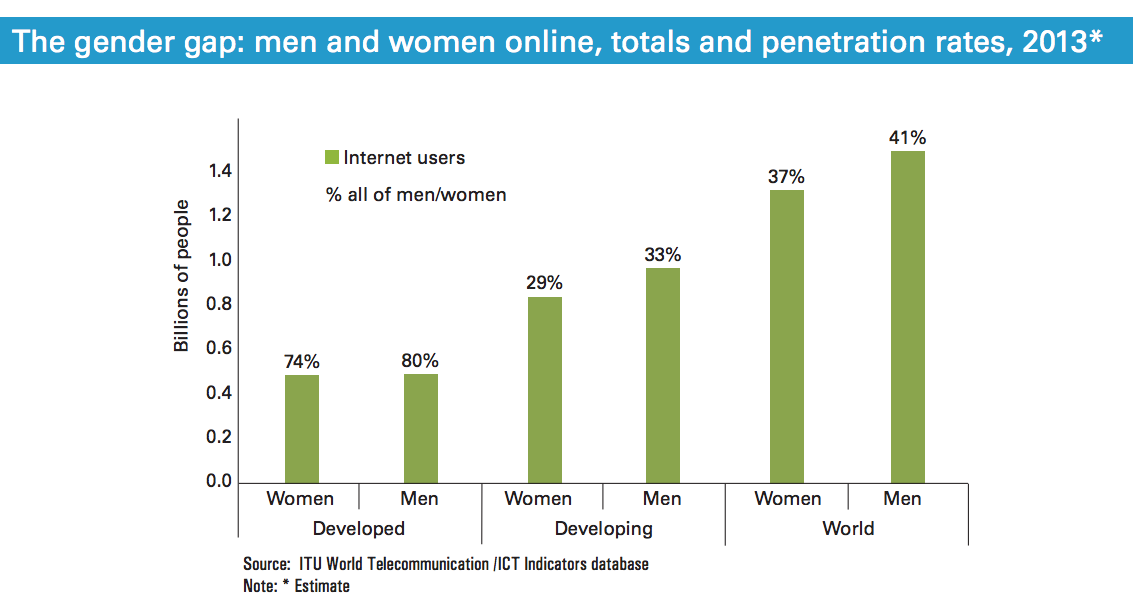
ITU estimates that 2.7 billion people – or 39% of the world’s population – will be using the Internet by end 2013.

Internet access, however, will remain limited in the developing world, with only 31% of the population forecast to be online at the end of 2013, compared with 77% in the developed world. Europe will remain the world’s most connected region with 75% Internet penetration, largely outpacing Asia and the Pacific (32%) and Africa (16%).

Household Internet penetration – often considered the most important measure of Internet access – continues to rise. By end 2013, ITU estimates that 41% of the world’s households will be connected to the Internet.

Over the past four years, household access has grown fastest in Africa, with an annual growth rate of 27%. But despite a positive general trend, 90% of the 1.1 billion households around the world that are still unconnected are in the developing world.

Gender Gap

The report also reveals for the first time global figures on the number of women (1.3 billion) and men (1.5 billion) using the Internet. The figures represent 37% of all women, compared with 41% of all men – but the gender gap is more pronounced in the developing world, where 16% fewer women than men use the Internet, compared with only 2% fewer women than men in the developed world. However, despite the disparities, the gender gap continues to close, with access to mobile technology increasingly within reach of women worldwide.

The full report can be accessed here [PDF].


The Way to Randomized Controlled Trials in Open Government

As I have written before, we may start to see a growing number of studies using randomized controlled trials (RCTs) to assess the validity of claims for transparency and participation. And in fact some donors in the open government space have already started to ask for RCT evaluations as a component of projects to be funded. But they might be skipping some important steps. A brief comment from the Simply Statistics blog suggests that a sequential approach (with RCTs at the end rather than at the start) might be more appropriate and cost-effective:

A really nice example where epidemiological studies are later confirmed by a randomized trial. From a statistician’s point of view, this is the idealized way that science would work. First, data that are relatively cheap (observational/retrospective studies) are used to identify potential associations of interest. After a number of these studies show a similar effect, a randomized study is performed to confirm what we suspected from the cheaper studies.

I think this consideration is particularly important for those funding open government evaluation work. Before jumping on the RCT bandwagon, one should first look at pre-existing knowledge to consider which questions are to be asked. But having followed the #opengov conversation for a while, I’d say this doesn’t happen very often.  

High-Frequency Data Using Mobile Phones: Incentives and Accountability

Great research note  [PDF] by Croke et al. (2012). Here’s the abstract:

As mobile phone ownership rates have risen dramatically in Africa, there has been increased interest in using mobile telephones as a data collection platform. This note draws on two largely successful pilot projects in Tanzania and South Sudan that used mobile phones for high-frequency data collection. Data were collected on a wide range of topics and in a manner that was cost-effective, flexible, and rapid. Once households were included in the survey, they tended to stick with it: respondent fatigue has not been a major issue. While attrition and nonresponse have been challenges in the Tanzania survey, these were due to design flaws in that particular survey, challenges that can be avoided in future similar projects. Ensuring use of the data to demand better service delivery and policy decisions turned out to be as challenging as collecting the high-quality data. Experiences in Tanzania suggest that good data can be translated into public accountability, but also demonstrate that just putting data out in the public domain is not enough. This note discusses lessons learned and offers suggestions for future applications of mobile phone surveys in developing countries, such as those planned for the World Bank’s “Listening to Africa” initiative.

Of particular interest to me is the fact that part of the design used financial incentives as a means to reduce nonresponse and attrition rates. In the technology and development world there has been lots of talk about “incentives to participate”, where the practical shortcut is often the provision of financial incentives. In Tanzania, for instance, the authors report that “respondents who successfully completed an interview were rewarded with an amount varying from $2 to $4”, not a negligible sum in the Tanzanian context.

Interestingly, in the working paper [PDF] from which this note is drawn, a footnote sheds some light on how effective these rewards were:

Remarkably in both Sudan and Tanzania the amount of the reward did not have a discernable impact on response rates.

But these findings are not as surprising as they may seem. Indeed, there is a good deal of evidence from behavioural economics pointing out that financial incentives might not work as well as traditional economics (and economists) would predict.

And a noteworthy excerpt on the limits of transparency and the role of existing institutions and actors:

One lesson is that  providing citizens with relevant, timely, and accurate data  about the actions of politicians, policy makers, and public service providers is not sufficient. For the data to have impact, they need to be accessible and disseminated widely, and in ways that allow them to be utilized by already existing institutions and actors.

This is an interesting point, although I am not sure to what extent existing institutions are enough. In the field of technology and governance, I believe that it has become quite clear that very little is achieved when technological solutions are not coupled with institutional innovations.

But that’s another story. In any case, a great read, and the type of effort that is badly needed in this space.

Institute for Local Government’s Public Engagement Program

https://i0.wp.com/www.ca-ilg.org/sites/main/files/pe_block_2_0.jpg


The Institute for Local Government’s Public Engagement program offers resources and support to help local officials and their communities design and carry out effective and inclusive public engagement activities. Topics include:

Public Engagement Basics

Broadening Participation

Difficult Situations in Public Engagement

Public Engagement Topic Areas

Measuring Success

Online Public Engagement & Technology

Sustaining Public Engagement

Thomas Malone on Collective Intelligence

THOMAS W. MALONE is the Patrick J. McGovern Professor of Management at the MIT Sloan School of Management and the founding director of the MIT Center for Collective Intelligence.

THOMAS W. MALONE is the Patrick J. McGovern Professor of Management at the MIT Sloan School of Management and the founding director of the MIT Center for Collective Intelligence.

Interesting video (and transcripts) of Thomas Malone (MIT Center for Collective Intelligence) at Edge (highlights are mine):

If it’s not just putting a bunch of smart people in a group that makes the group smart, what is it? We looked at bunch of factors you might have thought would affect it: things like the psychological safety of the group, the personality of the group members, et cetera. Most of the things we thought might have affected it turned out not to have any significant effect. But we did find three factors that were significantly correlated with the collective intelligence of the group.

The first was the average social perceptiveness of the group members. We measured social perceptiveness in this case using a test developed essentially to measure autism. It’s called the “Reading the Mind and the Eyes Test”. It works by letting people look at pictures of other people’s eyes and try to guess what emotions those people are feeling. People who are good at that work well in groups. When you have a group with a bunch of people like that, the group as a whole is more intelligent.

The second factor we found was the evenness of conversational turn taking. In other words, groups where one person dominated the conversation were, on average, less intelligent than groups where the speaking was more evenly distributed among the different group members.

Finally, and most surprisingly to us, we found that the collective intelligence of the group was significantly correlated with the percentage of women in the group. More women were correlated with a more intelligent group. Interestingly, this last result is not just a diversity result. It’s not just saying that you need groups with some men and some women. It looks like that it’s a more or less linear trend. That is, more women are better all the way up to all women. It is also important to realize that this gender effect is largely statistically mediated by the social perceptiveness effect. In other words, it was known before we did our work that women on average scored higher on this measure of social perceptiveness than men.

This is the interpretation I personally prefer: it may be that what’s needed to have an intelligent group is just to have a bunch of people in the group who are high on this social perceptiveness measure, whether those people are men or women. In any case, we think it’s an interesting finding, one that we hope to understand better and one that already has some very intriguing implications for how we create groups in many cases in the real world.

You can watch the video here.

Mobile and Development Intelligence Portal

https://dpzn40mpjrqb0.cloudfront.net/assets/carousel_image_4-e5116f7b0e4211739d45a617e3a78fed.jpg

The Mobile and Development Intelligence Portal is definitely worth taking a look, with awesome resources and data related to mobile technology.

Open Government and Technology: Groundhog Day

I came across a recent paper by Jan van Dijk that looks at the claims and achievements of digital democracy in the last 25 years. Here’s the abstract of  “Digital Democracy: Vision and Reality” [PDF] (highlights are mine):

Digital media have made a strong appeal to people wanting to improve democracy right from the start. Four waves of utopian visions of the last 25 years are described. The concept of digital democracy is defined. Subsequently, six views of both representative and direct democracy are distinguished that favor particular applications of digital media in politics and government.  The next paragraph makes an inventory of the claims and achievements of 25 years of attempts to realize digital democracy in the field of information provision, online discussion and decision-making. It appears that information provision is the best realized claim. The final part of this chapter is about eParticipation in politics and policy. It discusses both government- and citizen-centric applications. Citizen-centric applications appear to be the most successful. Generally speaking, e-participation has not been successfully incorporated in institutional politics and government.

Van Dijk’s paper adds to my list of readings on how little can be achieved by technology [PDF] in the absence of institutional change (something few seem to care about / understand).

But it also brings me to another issue that I think is not stressed enough: the current enthusiasm around technology and open government strikes me due to its lack of historical perspective. And, if history serves as any guide, advocates in the open government space would fare better in managing their (and others’) expectations about what can and cannot be achieved by technology.

Belgian sociologist Armand Mattelart.

Belgian sociologist Armand Mattelart.

This reminds me of a quote I read in an article from 1994 by Armand Mattelart on the “promise of redemption” of communication technologies. The author refers to a speech by then vice-president Al Gore in 1994 at the International Telecommunications Union (ITU), defending the creation of the Global Information Infrastructure (GII). Al Gore’s view for democracy and information technologies couldn’t be any more enthusiastic:

The GII will not only be a metaphor for a functioning democracy, it will in fact promote the functioning of democracy by greatly enhancing the participation of citizens in decision-making. And it will greatly promote the ability of nations to cooperate with each other. I see an new Athenian Age of democracy forged in the fora the GII will create.

Nearly 20 years later, hopes similar to those of Al Gore can still resonate in blog posts, conferences and official documents.

I can’t help but think of what Mattelart called “a strange alchemy of cynicism, naïveté and amnesia”.

Digital Cities: The Internet and the Geography of Opportunity

A new title in the series of Oxford Studies in Digital Politics (edited by Andrew Chadwick), has just been published: Digital Cities: The Internet and the Geography of Opportunity, by Karen Mossberger, Caroline J. Tolbert, and William W. Franko.

Digital Cities tells the story of information technology use and inequality in American metropolitan areas and discusses directions for change. The authors argue that mobile-only Internet, the form used by many minorities and urban poor, is a second-class form of access, as they offer evidence that users with such limited access have dramatically lower levels of online activity and skill. Digital citizenship and full participation in economic, social and political life requires home access. Using multilevel statistical models, the authors present new data ranking broadband access and use in the nation’s 50 largest cities and metropolitan areas, showing considerable variation across places. Unique, neighborhood data from Chicago examines the impact of poverty and segregation on access in a large and diverse city, and it parallels analysis of national patterns in urban, suburban and rural areas. Digital Cities demonstrate the significance of place for shaping our digital future and the need for policies that recognize the critical role of cities in addressing both social inequality and opportunity.

Find out more about it here.