Lawrence Lessig on Sortition and Citizen Participation


When designing citizen engagement mechanisms I always consider sortition (or randomization) as a mechanism of participant selection. Nevertheless, and particularly in the #opengov space, my experience is that this idea does not resonate a lot: it sounds less sexy than crowdsourcing and more complicated than over-simplistic mechanisms of “civil society engagement”.

This is why it is always great to see someone like Lawrence Lessig putting forward a system of  “Citizen Conventions” for proposing amendments to the Constitution based upon sortition. In this video below, at a hearing at the U.S. Senate’s Commission of Justice, Lessig explains in a few seconds how such a system would work:

With his unique eloquence, Lessig also makes the best case for ordinary citizens to engage with the Constitution and reforms:

I think to the surprise of many people, you would see that ordinary people deliberating about what the Constitution needs and how the reforms should go forward, would far surpass ninety eight percent of what is commonly discussed in this particular context. And that’s because, frankly, politics is the one sport where the amateur is better for the nation than the professional.

Lessig’s remark on the amateur’s role in politics reminds me of something I read a while ago from the apologue of Protagoras. When charged with taking to humans the art of politics, Mercury asks Jupiter whether it should be distributed like the other arts, to the competent ones only. Jupiter replies that the art of politics should be distributed to all. Otherwise, says Jupiter, the city would not exist.

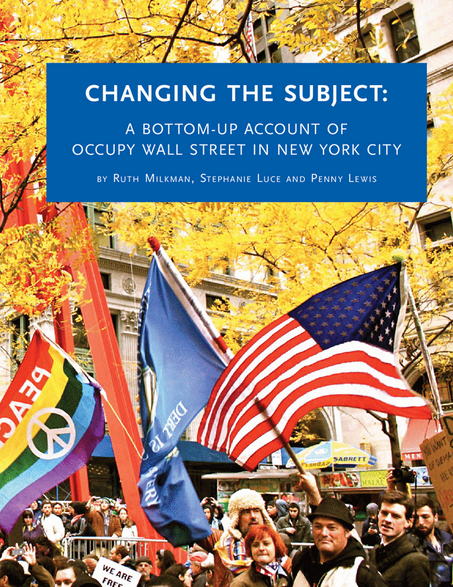
A Bottom-up Account of Occupy Wall Street

New report on Occupy Wall Street in New York City.

Screen Shot 2013-01-29 at 08.46.39

Some of the findings:

  • Highly educated young adults were overrepresented
    among OWS activists and supporters, a group with
    limited ethnic/racial or class diversity
  • Most OWS activists and supporters were deeply
    skeptical of the mainstream political system as an
    effective vehicle for social change. For some, this
    skepticism intensified after the election of Barack
    Obama in 2008 failed to produce the changes they
    had been led to expect.
  • Despite being disillusioned with mainstream
    politics, many OWS activists and supporters
    remain politically active and civically engaged.
  • OWS was able to attract supporters with a wide
    variety of specific concerns, many of whom had
    not worked together before, This was in large part
    because it made no formal “demands,” and united
    around the “We Are the 99%” slogan.

Read the full report here.

(HT Archon Fung)

Democratic Innovation in Open Government

The Oregon Citizen’s Initiative Review is without doubt one of the most interesting recent innovations in the field of citizen engagement.

Here’s an excerpt from Participedia on the initiative:

The Oregon Citizen Initiative Review (Oregon CIR) is a Citizens’ Initiative Review designed to allow citizens of the U.S. state of Oregon to evaluate statewide ballot initiatives. A Citizens’ Initiative Review (CIR) is a Citizens’ Jury that deliberates about a ballot initiative. The Oregon CIR is intended to give voters clear, useful, and trustworthy evaluations of initiatives on the ballot. (…)

The Oregon CIR involves four categories of participants: panelists, the citizens who deliberate about a ballot initiative; advocates, individuals who are knowledgeable about the ballot initiative and who argue in support of or in opposition to the ballot initiative; stakeholders, individuals who will be affected by the ballot initiative, who also argue in support of or in opposition to the ballot initiative; and background witnesses, individuals who are knowledgeable about issues related to the initiative, and who present neutral background information about those issues to the panelists. (…)

I have written before about different methods of participant selection, and this is one of the strong points of this initiative:

To select the panelists for the 2010 Oregon CIRs, HDO used the following selection process: HDO took a probability sample of 10,000 Oregon voters. All voters in this sample were sent an invitation to participate in the 2010 Oregon CIR and a demographic survey. Three hundred fifty members of the sample responded, for a response rate of 3.5%. From those who responded, HDO, using the demographic data from the sample survey, anonymously chose 24 panelists, and 5 alternate panelists, for each 2010 Oregon CIR. The panelists and alternates for each CIR were chosen using stratification, so that each panel closely matched the Oregon population in terms of place of residence, political partisanship, education, ethnicity/race, gender, and age.

If advocates and policymakers in the open government space are really serious about citizen engagement, this is the sort of institutional innovation they should be looking at. Unfortunately, this doesn’t seem to be happening.

Find out more about it at http://healthydemocracy.org/

My Reading Suggestions (Part One)

Fundação Biblioteca Nacional

Tom Steinberg asked me for a list of my favorite recent reads. So here’s the first part of a rather disorganized list of readings and other resources, with sporadic comments on why I like some of them. The list is heterogeneous in terms of subject, method and quality. In my opinion, the common denominator among the different resources is their relevance for those working at the intersection of participation and technology.

ON COLLECTIVE INTELLIGENCE

There is definitely a lot of bad reading out there about collective intelligence.   Indeed, many of the discussions and papers out there are nothing more than half-baked re-readings of ideas and concepts well established in the field of epistemic democracy. But there are a few exceptions. Acquainting myself with Hélène’s awesome work in the domain was one of the highlights for me in 2012. Here’s a sample:

Landemore, Hélène E., Democratic Reason: The Mechanisms of Collective Intelligence in Politics (April 1, 2011). COLLECTIVE WISDOM: PRINCIPLES AND MECHANISMS, Hélène Landemore and Jon Elster, eds., Cambridge University Press, Spring 2012.

You can find more of Hélène’s work here http://www.helenelandemore.com/.

Also, if you are interested in high-level talks and discussions about collective intelligence, the videos of conferences below are some of the best things out there:

Collective Intelligence Conference (Video)

College de France – Collective Intelligence (Video) 

Epistemic Democracy Conference (Video) 

ON COLLECTIVE ACTION

Miller, J & Page, S 2004, ‘The Standing Ovation Problem’, COMPLEXITY, vol. 9, no. 5, pp. 8-16.

Bond, R. M., C. J. Fariss, J. J. Jones, A. D. I. Kramer, C. Marlow, J. E. Settle, and J. H. Fowler.  2012. “A 61-Million-Person Experiment in Social Influence and Political Mobilization.”  Nature 489: 295–298.

S. Gonzalez-Bailon, J. Borge-Holthoefer, A. Rivero, and Y. Moreno. The Dynamics of Protest Recruitment through an Online Network. Nature, December 2011.

Margetts, Helen Zerlina, John, Peter, Reissfelder, Stephane and Hale, Scott A., Social Influence and Collective Action: An Experiment Investigating the Effects of Visibility and Social Information Moderated by Personality (April 18, 2012).  

Hale, Scott A. and Margetts, Helen Zerlina, Understanding the Mechanics of Online Collective Action Using ‘Big Data’ (March 22, 2012).

ON DELIBERATION

David Lazer is the co-author of two of these papers. If you don’t know it already, Stuart Shulman’s work is definitely worth checking out. Thamy Pogrebinschi is probably one of the people to look out for in the coming years in the field of participatory democracy.

Lazer, David, Sokhey, Anand E., Neblo, Michael A. and Esterling, Kevin M., Deliberative Ripples: The Network Effects of Political Events (August 10, 2010).

Neblo, Michael A., Esterling, Kevin M., Kennedy, Ryan, Lazer, David and Sokhey, Anand E., Who Wants to Deliberate – and Why? (September 15, 2009). HKS Working Paper No. RWP09-027.

Stuart W. Shulman, 2009. “The case against mass e–mails: Perverse incentives and low quality public participation in U.S. federal rulemaking,” Policy & Internet, volume 1, number 1, article 2.

Pogrebinschi, Thamy, The Squared Circle of Participatory Democracy: Scaling-up Deliberation to the National Level (2012). APSA 2012 Annual Meeting Paper. 

THE ROI OF CITIZEN ENGAGEMENT:

Largely unknown even among the most enthusiastic participation advocates, there is a growing body of literature in the field of tax morale that links citizen engagement to reduced tax evasion: one of the best cases for the ROI of Open Government.  Below is one of the best papers in the field.

Frey, Bruno S., and Lars P. Feld (2002) “Deterrence and Morale in Taxation: An Empirical Analysis.” CESifo Working Paper no. 760, August 2002

You can find more references about tax morale here. Alex Howard gives a good account of how this might be happening in the DR Congo, helped by mobile phones (a project I’m part of).

And if the subject is the ROI of open government, here’s a paper that links participatory budgeting to reduced infant mortality (and there’s more to be published on that front soon).

RANDOMIZED CONTROLLED TRIALS AND OPEN GOVERNMENT

If I were to make any predictions for 2013, I would say we will start to see a growing number of studies using randomized controlled trials (RCTs) to assess the validity of claims for transparency and participation. Indeed, some donors in the open government space have already started to ask for RCT evaluations as a project component. Here are a couple of examples of how good studies on the subject would look (IMHO):

Olken, B. 2010. Direct Democracy and Local Public Goods: Evidence from a Field Experiment in Indonesia. American Political Science Review, 104, pp 243-267

Zhang, K. 2012. “Increasing Citizen Demand for Good Government in Kenya”. Stanford University. 

Of course, scholars, practitioners and donors should take claims about the awesomeness of RCTs with a good grain of salt (and pepper):

Deaton, A. 2008. Instruments of development? Randomization in the tropics, and the hunt for the keys to development. Princeton University mimeo.

Cartwright, N. 2007. “Are RCTs the gold standard?” Biosocieties, 2, 11–20.

FUN STUFF ON TURNOUT AND ELECTIONS

Rothschild, David and Justin Wolfers. 2011. “Forecasting Elections: Voter Intentions versus Expectations.” Working paper, University of Pennsylvania.

Gomez, Brad T., Thomas G. Hansford, and George A. Krause. 2007. “The Republicans Should Pray for Rain: Weather, Turnout, and Voting in U.S. Presidential Elections.” Journal of Politics 69 (August): 649–63.

This is just the first part of a longer list. I hope to finish a second part soon, focusing – among other things – on the (uneasy) intersection of behavioural economics and participatory democracy.

Happy reading.

Open Government and Technology: Groundhog Day

I came across a recent paper by Jan van Dijk that looks at the claims and achievements of digital democracy in the last 25 years. Here’s the abstract of  “Digital Democracy: Vision and Reality” [PDF] (highlights are mine):

Digital media have made a strong appeal to people wanting to improve democracy right from the start. Four waves of utopian visions of the last 25 years are described. The concept of digital democracy is defined. Subsequently, six views of both representative and direct democracy are distinguished that favor particular applications of digital media in politics and government.  The next paragraph makes an inventory of the claims and achievements of 25 years of attempts to realize digital democracy in the field of information provision, online discussion and decision-making. It appears that information provision is the best realized claim. The final part of this chapter is about eParticipation in politics and policy. It discusses both government- and citizen-centric applications. Citizen-centric applications appear to be the most successful. Generally speaking, e-participation has not been successfully incorporated in institutional politics and government.

Van Dijk’s paper adds to my list of readings on how little can be achieved by technology [PDF] in the absence of institutional change (something few seem to care about / understand).

But it also brings me to another issue that I think is not stressed enough: the current enthusiasm around technology and open government strikes me due to its lack of historical perspective. And, if history serves as any guide, advocates in the open government space would fare better in managing their (and others’) expectations about what can and cannot be achieved by technology.

Belgian sociologist Armand Mattelart.

Belgian sociologist Armand Mattelart.

This reminds me of a quote I read in an article from 1994 by Armand Mattelart on the “promise of redemption” of communication technologies. The author refers to a speech by then vice-president Al Gore in 1994 at the International Telecommunications Union (ITU), defending the creation of the Global Information Infrastructure (GII). Al Gore’s view for democracy and information technologies couldn’t be any more enthusiastic:

The GII will not only be a metaphor for a functioning democracy, it will in fact promote the functioning of democracy by greatly enhancing the participation of citizens in decision-making. And it will greatly promote the ability of nations to cooperate with each other. I see an new Athenian Age of democracy forged in the fora the GII will create.

Nearly 20 years later, hopes similar to those of Al Gore can still resonate in blog posts, conferences and official documents.

I can’t help but think of what Mattelart called “a strange alchemy of cynicism, naïveté and amnesia”.

David Karpf on Netroots and the MoveOn Effect

David Karpf lecture at the American University on the impact of technologies on political activism.


A brief description of the talk from the Center for Social Media website:

Karpf walked his audience through an examination of internet age advocacy organizations: examining their effectiveness in running campaigns; how they run campaigns as compared to legacy advocacy groups such as the Sierra Club (an organization that predates the internet by nearly 100 years); and what the future of the netroots movements means for the future of all who are involved in advocacy work. Karpf, who served on the Sierra Club board of directors in graduate school, came equipped with a perspective that combines the physical experience of his grassroots campaign work and the intellectual experience of meticulously mapping the behavior and patterns of online groups such as DailyKos and MoveOn.

Podcasts – Democracy and Resistance

Podcasts of the “Democracy and Resistance” conference, held last June, are available here. A good start in my opinion are the podcasts of Jane Mansbridge and Yves Sintomer .

Below, the list of podcasts. (Hat tip ABC Democracy)

Introduction: Regina Kreide
podcast

Democracy in Crisis?

Hartmut Rosa: The Politics of Speed and the Loss of Resonance: How Social Acceleration Causes Democratic Alienation

Hauke Brunkhorst: Crisis of Democracy in Europe

Jodi Dean: Occupy Wall Street: Claiming Division

Costas Douzinas: Athens Revolting: Disobedience and Resistance in the Crisis

Forms of Resistance

Chris Thornhill: Revolutionary Constituent Power and the Transnational Constitutional Order

Rada Ivekovic: Sovereignty, Resistance, Citizenship and Subjectivation in a New Context

Robin Celikates: Civil Disobedience and the Question of Violence

Banu Bargu: Biopolitics and Human Shields

Gertrud Koch: Mass and/as Medium

Juliane Rebentisch: Theatrocracy: The Scene of Democratic Sovereignty

Democracy Revisited

Andreas Niederberger: Participation Reconsidered: Constellational Citizenship and the Plurality of Means and Forms of Democratic Participation

Andreas Kalyvas: Radical Democracy and Constituent Power

Yves Sintomer: Citizen Participation – A Response to the Global Crisis?

Oliver Marchart: Democratic Protest and Its Discontents

Jane Mansbridge: Resisting Resistance

Democracy by Sortition, Government by Lot

Personally, I am a strong sympathiser of democracy by sortition.

Historically, the main references to government by sortition refer to Classical Athens and the Florentine Republic in the Early Renaissance.

View of the Palazzo Vecchio in Florence. Picture by jrgcastro on flickr.

For those interested in the Florentine experience, in general less known to the public, here’s a great draft paper [pdf] by Yves Sintomer that he presented during a meeting we had a couple of years ago at the Rockefeller Center in Bellagio. In the paper, among other things, Yves describes the experience of the Florentine Republic and contrasts it with recent democratic innovations based on random selection. As to these recent experiments, alongside citizens’ juries,  probably one of the most studied experiments with sortition in recent history refers to British Columbia’s Citizens’ Assembly on Electoral Reform.

At a time when citizen participation is considered – at least in theory – an important part of the open government movement, those working in this sphere should pay particular attention to different methods of participant selection (e.g. self-selection, randomized) and what the prospects and limits for each of these different methods are.

An awesome read on this subject is the book Democratic Innovations by Graham Smith. Among other things, Graham looks at the impact that different  institutional designs (and methods of selection) have on the inclusiveness of participatory experiences.

If you are interested in sortition, a good resource to follow is the Equality by Log blog. In the blog I just came across an interesting presentation [PDF] by Yoram Gat on the subject of sortition compared to traditional (i.e. representative) democratic institutions.

Maybe after some of these readings you may become a sympathiser of government by lot as well.

Has Democratization Reduced Infant Mortality in Sub-Saharan Africa?

picture by Teseum on flickr.

Masayuki Kudamatsu (2006)

Does democracy help babies survive in sub-Saharan Africa? By using retrospective fertility surveys conducted in 28 African countries, I compare the survival of infants born to the same mother before and after democratization to identify the effect of democracy. In measuring democracy, I adopt a theoretically motivated definition of democracy: universal suffrage and contested elections for executive office. I find that infant mortality falls by 1.8 percentage points, 18 percent of the sample mean, after democratization. The size of the reduction is larger for babies born to mothers from disadvantaged groups. I also find that the replacement of a chief executive by democratization is the driving force behind these results. Additional evidence suggests that improvements in public health service delivery, not an increase in affluence, are the key mechanism in which democratization has reduced infant mortality.

Download [PDF] here. 

Pippa Norris – Making Democratic Governance Work

Here’s something new by Pippa Norris. Definitely worth reading

“Making Democratic Governance Work : How Regimes Shape Prosperity, Welfare, and Peace”

This book focuses on three core questions. Is democratic governance good for economic prosperity? Has this type of regime accelerated progress toward achieving the Millennium Development Goals, social welfare, and human development? Does it generate a peace-dividend and reduce conflict at home? Despite the importance of understanding these questions and the vast research literature generated, remarkably little consensus has emerged about any of these issues. Within the international community, democracy and governance are widely advocated as intrinsically desirable and important goals. Nevertheless, alternative schools of thought continue to dispute their consequences – and thus the most effective strategy for achieving a range of critical developmental objectives. Some believe that human development is largely determined by structural conditions in each society, such as geographic location, natural resources, and the reservoir of human capital, so that regimes have minimal impact. Others advocate promoting democracy to insure that leaders are responsive to social needs and accountable to citizens for achieving better schools, clinics, and wages. Yet others counter that governance capacity is essential for delivering basic public services, and state-building is essential in post-conflict reconstruction prior to holding elections. This book advances the argument that both liberal democracy and state capacity need to be strengthened in parallel to ensure effective development, within the constraints posed by structural conditions. Liberal democracy allows citizens to express their demands, to hold public officials to account, and to rid themselves of incompetent, corrupt, or ineffective leaders. Yet rising public demands that cannot be met by the state are a recipe for frustration, generating disillusionment with incumbent officeholders, or, if discontent spreads to becomes more diffuse, with the way that the regime works, or even ultimately with the promise of liberal democracy ideals. Thus governance capacity is also predicted to play a vital role in advancing human security, so that states have the capacity to respond effectively to citizen’s demands. The argument is demonstrated using systematic evidence gathered from countries worldwide during recent decades and selected cases illustrating the effects of regime change on development.

You can order the book here.