Interests, Information and Minority Influence in Deliberation

Good paper [PDF] by Daniel Myers (University of Michigan)

Interests, Information and Minority Influence in Deliberation

Daniel Myers (2012)

Abstract:

The ability of citizens to share information is essential to the success of deliberative institutions. This paper builds on game-theoretic models of strategic information transmission to offer a theory of how the interests that deliberators have in the outcome of deliberation can cause some citizens to be unable to share information or influence the deliberative process. Specifically, this paper argues that whether a person is able to share information depends on whether that person is in the majority or the minority in terms of their interest in the outcome of deliberation. Deliberating groups will discount information that is provided by members of the minority, even when this information is an important contribution to deliberation. I offer the first empirical test of this kind of model in realistic deliberative conditions using two experiments, a laboratory experiment and a field experiment, and find that arguments that are made by members of the minority are less influential than the same arguments when they are made by members of the majority. The paper concludes by discussing the implications of these findings for the equality and epistemic quality of deliberative institutions.

Pippa Norris – Making Democratic Governance Work

Here’s something new by Pippa Norris. Definitely worth reading

“Making Democratic Governance Work : How Regimes Shape Prosperity, Welfare, and Peace”

This book focuses on three core questions. Is democratic governance good for economic prosperity? Has this type of regime accelerated progress toward achieving the Millennium Development Goals, social welfare, and human development? Does it generate a peace-dividend and reduce conflict at home? Despite the importance of understanding these questions and the vast research literature generated, remarkably little consensus has emerged about any of these issues. Within the international community, democracy and governance are widely advocated as intrinsically desirable and important goals. Nevertheless, alternative schools of thought continue to dispute their consequences – and thus the most effective strategy for achieving a range of critical developmental objectives. Some believe that human development is largely determined by structural conditions in each society, such as geographic location, natural resources, and the reservoir of human capital, so that regimes have minimal impact. Others advocate promoting democracy to insure that leaders are responsive to social needs and accountable to citizens for achieving better schools, clinics, and wages. Yet others counter that governance capacity is essential for delivering basic public services, and state-building is essential in post-conflict reconstruction prior to holding elections. This book advances the argument that both liberal democracy and state capacity need to be strengthened in parallel to ensure effective development, within the constraints posed by structural conditions. Liberal democracy allows citizens to express their demands, to hold public officials to account, and to rid themselves of incompetent, corrupt, or ineffective leaders. Yet rising public demands that cannot be met by the state are a recipe for frustration, generating disillusionment with incumbent officeholders, or, if discontent spreads to becomes more diffuse, with the way that the regime works, or even ultimately with the promise of liberal democracy ideals. Thus governance capacity is also predicted to play a vital role in advancing human security, so that states have the capacity to respond effectively to citizen’s demands. The argument is demonstrated using systematic evidence gathered from countries worldwide during recent decades and selected cases illustrating the effects of regime change on development.

You can order the book here. 

Does access to information enhance accountability?

This paper [PDF] examines whether access to information enhances political accountability. Based upon the results of Brazil’s recent anti-corruption program that randomly audits municipal expenditures of federally-transferred funds, it estimates the effects of the disclosure of local government corruption practices upon the re-election success of incumbent mayors. Comparing municipalities audited before and after the elections, we show that the audit policy reduced the incumbent’s likelihood of re-election by approximately 20 percent, and was more pronounced in municipalities with radio stations. These findings highlight the value of information and the role of the media in reducing informational asymmetries in the political process. 

Ferraz, Claudio, and Frederico Finan. 2008. “Exposing Corrupt Politicians: The Effects of Brazil’s Publicly Released Audits on Electoral Outcomes.” Quarterly Journal of Economics, 123(2): 703–45.

I Paid a Bribe. So What?

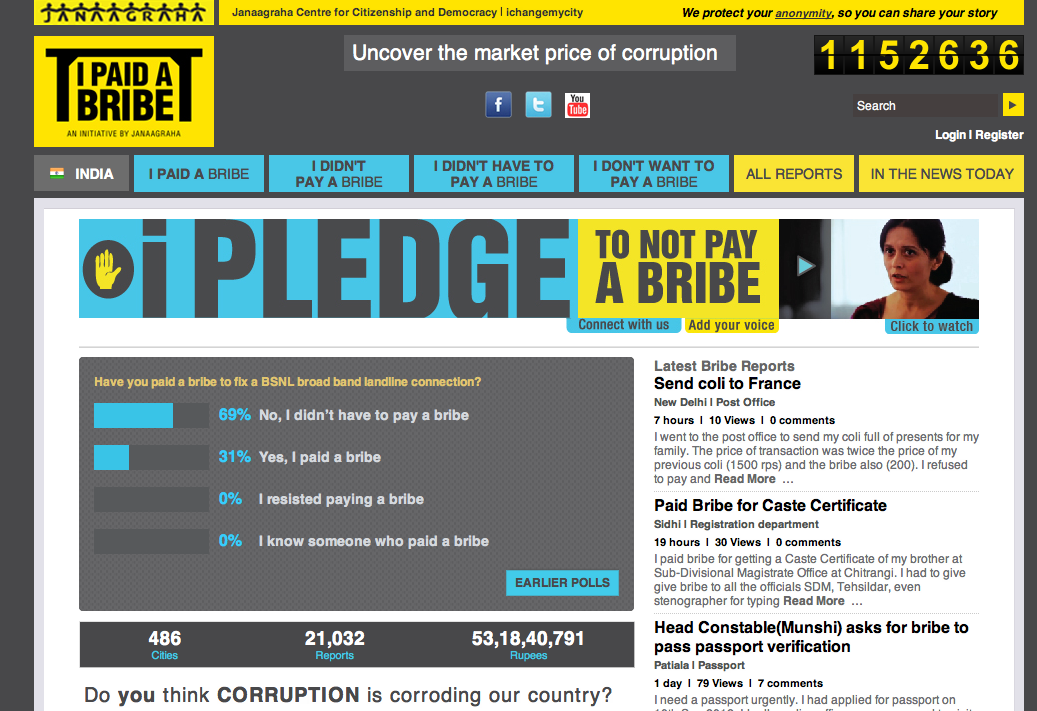
I Paid a Bribe

As is often the case for many people these days, the first time I saw the Indian version of “I Paid a Bribe” I was quite excited about it. The overarching principle is simple: if you paid a bribe, you report it (it’s more than that, but you can check it out on the website for yourself).

I find these websites particularly interesting in the sense that anger and frustration (in that case having to pay a bribe) may be good drivers of action, as suggested by some political behavior research (see for instance here and here).

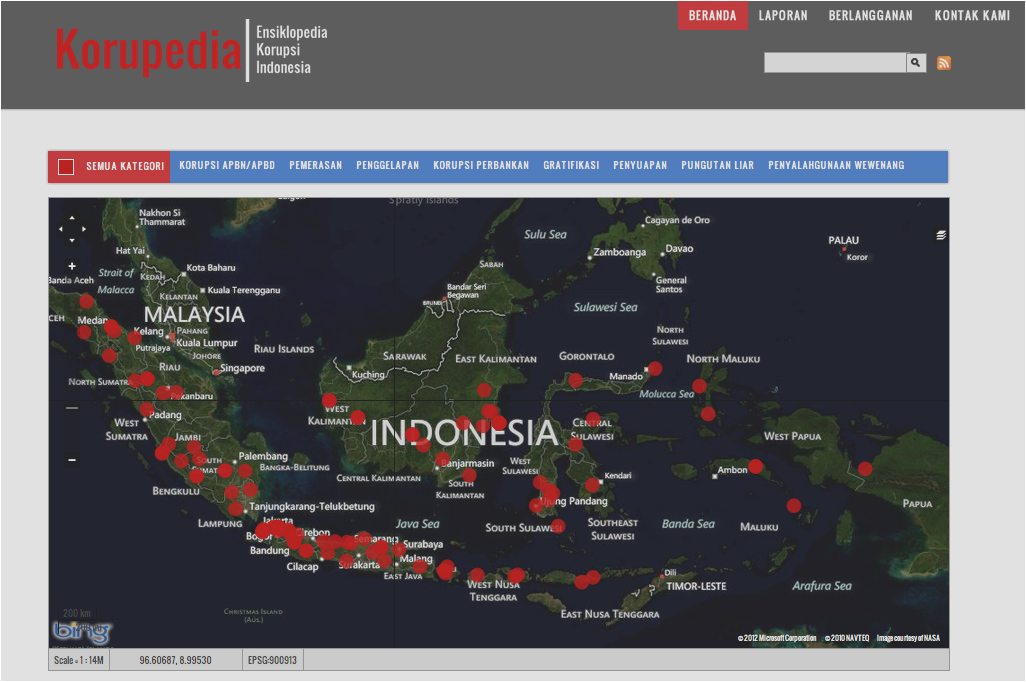
This morning I was pleasantly surprised to discover through the website that there are already four other websites of this kind (in Kenya, Indonesia, Zimbabwe and Pakistan) and two others are to be launched soon (in Philippines and Mongolia). Although scalability has very little to do with impact – a point that is often ignored – it is always good to find out that people in other places are trying to actually do something to tackle corruption.

Korupedia

Korupedia

Nevertheless, it is still not clear for me what the working hypothesis of these websites is (let alone their actual impact). Or, as pseudo-intellectuals nowadays put it, I am not sure what their “theory of change” is. Below is a non-comprehensive list of how these websites may be – hypothetically – efficient in the reduction of corruption:

1) By giving visibility to corruption, governments are more likely to take effective measures to reduce corruption.

2) Public agents will be less likely to ask for bribes given the possibility that their act may be publicly reported.

3) Individuals and societal agents themselves will mobilize against corruption as they realize that corruption is an endemic problem in their country.

The different hypotheses are by no means mutually exclusive. However, singling out each one of them is important for at least three reasons.

First, clarifying the mechanism through which one expects to address an issue facilitates the development of a more efficient strategy. For instance, if what you expect is that government will be more likely to take action once corruption is publicized, you should deploy specific actions towards governmental actors who are in positions to make a difference.

Second, understanding the underlying mechanisms by which change is expected to happen provides us with a reality check of how effective these initiatives may actually be. Will politicians and government officials become more inclined to combat corruption once they “find out” that there is too much corruption in the country? Will public officials be less likely to engage in corrupt activities due to the fact that it can be reported on a third party website? The answers to these questions are not as straightforward as they might appear to be, and identifying any change on that front may be particularly challenging.

This brings us to a third and particularly important issue, which refers to assessing the impact of these initiatives. Surely, measuring the effect that such websites may have on the overall level of corruption in a country is a complicated task. For instance, supposing such websites gain significant popularity in their countries, the increased visibility of corruption may have a seemingly paradoxical effect: while the actual number of corruption cases may decrease as the risk of publicization becomes a real one, citizens may come to perceive increases in levels of corruption as cases that previously would have been undisclosed come to their attention. In that case, for example, the use of the corruption perception index would be of little utility to assess variance in corruption levels across countries.

Nevertheless, finding alternative methods to track the impact of these initiatives is only possible if one has a clear understanding of the ways in which these innovations are supposed to operate in order to have an impact on corruption. For example, if we expect government to take action as the issue gains visibility, tracking the real number of administrative procedures (e.g. investigations, sanctions) related to corruption might be a start (although more would be needed to infer any causality).

The difficulty of assessment is clear, particularly for organizations that are in many cases under-resourced and struggling to keep their operations going. But not doing it will always be counter-productive in the long term. Without any evidence of impact, as sexy as these initiatives may seem, they will not survive the “so what” question.

The Guardian on Participatory Budgeting

The Guardian has come up with an interesting piece on Porto Alegre’s participatory budgeting, highlighting some of the benefits (well-known to some) of the process:

The effects have been overwhelmingly positive. Within seven years, the percentage of locals with access to sewers doubled from 46 to 95. The rate of roadbuilding, particularly in the favelas, rose five-fold. Tax evasion fell, as people saw what their money was being spent on.

Read the full article here.


Participatory Budgeting: Seven Defining Characteristics

I am often asked for definitions of participatory budgeting. Normally, I use the following definition in my texts:

“Participatory budgeting (PB) can be broadly defined as the participation of citizens in the decision-making process of budget allocation and in the monitoring of public spending.”

Nevertheless, while easy to understand, this definition opens the door to a big (and annoying) interpretation problem: some might think that simple budget consultations are the same as participatory budgeting, and they are not.

In my opinion, there are no perfect definitions, with different authors stressing different points. Based on the literature that I have read, I think that participatory budgeting – at least ideally – should present the following seven characteristics:

1) Public budgets are the object of the process, or at least part of it (it is not urban planning)

2) Citizen participation has a direct impact on the budget (it is not a consultation)

3) Citizens decide on the rules governing the process

4) The process has a deliberative element (it is not like the Swiss fiscal referendum for example)

5) A redistributive logic is embedded in the design of the process (e.g. poorest districts / areas get more money and vice-versa)

6) The process is institutionally designed to ensure that citizens can monitor public spending

7) The process is repeated periodically (e.g. on a yearly basis)

Of course, I am probably missing and adding elements that many scholars would point out. Some might fairly consider my interpretation as too orthodox: a number of initiatives that we call PB rarely combine all seven elements.

Just in case, a few other definitions / descriptions of the process:

Here’s a practical definition, based on five criteria:

“(1) The financial and/or budgetary dimension must be discussed; participatory budgeting is dealing with scarce resources.

(2) The city level has to be involved, or a (decentralised) district with an elected body and some power over administration (the neighbourhood level is not enough).

(3) It has to be a repeated process (one meeting or one referendum on financial issues are not examples of participatory budgeting).

(4) The process must include some form of public deliberation within the framework of specific meetings/ forums (the opening of administrative meetings or classical representative instances to normal citizens is not participatory budgeting).

(5) Some accountability on the output is required.”

Source: Sintomer, Y., C. Herzberg and G. Allegretti, 2011. Learning from the South: Participatory Budgeting Worldwide – an Invitation to Global Cooperation. Dialog Global, No. 25  [PDF]

Another one is from a seminal article by Boaventura de Souza, based on guiding principles. An important element in this definition: citizens are the ones who decide the internal rules that govern the participatory process.

“The participatory budgeting is a structure and a process of community participation based on three major principles and on a set of institutions that function as mechanisms or channels of sustained popular participation in the decision-making process of the municipal government. The three principles are:

a) All citizens are entitled to participate, community organizations having no special status or prerogative in this regard;

b) Participation is governed by a combination of direct and representative democracy rules and takes place through regularly functioning institutions whose internal rules are decided upon by the participants;

c) Investment resources are allocated according to an objective method based on a combination of “general criteria” – substantial criteria established by the participatory institutions to define priorities – and “technical criteria” – criteria of technical or economic viability as defined by the executive and federal, state, or city legal norms – that are up to the executive to implement.”

Source: Santos, Boaventura de Souza. 1998. “Participatory Budgeting in Porto Alegre: Toward a Redistributive Democracy.” Politics & Society [PDF]

Another definition, by the PB veteran Brian Wampler, stresses a major element often forgotten by scholars and advocates: the monitoring of public spending. Another important element refers to the redistributive nature of PB (e.g. poorest neighborhoods get more money).

“Participatory Budgeting (PB) programs are innovative policymaking processes. Citizens are directly involved in making policy decisions. Forums are held throughout the year so that citizens have the opportunity to allocate resources, prioritize broad social policies, and monitor public spending. These programs are designed incorporate citizens into the policymaking process, spur administrative reform, and distribute public resources to low-income neighborhoods. Social and political exclusion is challenged as lowincome and traditionally excluded political actors are given the opportunity to make policy decisions. Governments and citizens initiate these programs to (i) promote public learning and active citizenship, (ii) achieve social justice through improved policies and resources allocation, and (iii) reform the administrative apparatus.”

Source: Wampler, B. 2000. “A Guide to Participatory Budgeting.” Paper presented at the Conference on the Participatory Budget, Porto Alegre, Brazil. [PDF]

A couple of other, shorter definitions:

• One often used by advocates in the US:

“Participatory budgeting (PB) is a democratic process in which community members directly decide how to spend part of a public budget. […]”

Source: http://www.watsonblogs.org/participatorybudgeting/aboutpb.html

• Another one used by the PB Unit in the UK (and the Department of Communities and Local Government – DCLG UK Govt.):

“Participatory budgeting directly involves local people in making decisions on the spending and priorities for a defined public budget. PB processes can be defined by geographical area (whether that’s neighbourhood or larger) or by theme. This means engaging residents and community groups representative of all parts of the community to discuss and vote on spending priorities, make spending proposals, and vote on them, as well giving local people a role in the scrutiny and monitoring of the process and results to inform subsequent PB decisions on an annual or repeatable basis.”

I hope that helps.
Mapping Social & Environmental Risks in Rio de Janeiro

From the InSTEDD iLab Latin America blog

The main idea behind this project was to create a simple, low cost way to allow the youth living in the favelas to digitally map the socio-environmental risk factors that threatened their communities. We needed to do it in a way that would be publicly visIble so that the government and the public could be aware and respond.

Below a video on the first stage of the initiative

Definitely something to follow up on. It would be interesting to find out more about how they are planning to asses the impact of the initiative. In my very limited experience, most mapping initiatives are exciting to see but fail to show a link between outputs (e.g. maps) and tangible outcomes (i.e. impact). Let’s hope this initiative is one of the exceptions.

Trust and Political Information: Attitudinal Change in Participants in the Youth Parliament in Brazil


This article analyses the impact of socializing experiences on the political attitudes of youngsters. More specifically, our goal is to evaluate the impact of the Youth Parliament program on youngsters’ confidence levels in the Minas Gerais State Assembly (MGSA). The analysis focuses on the cognitive foundations of attitudes and results show a substantial increase in confidence levels in MGSA, an increase associated with the acquisition of information on the institution. It is asserted that the increase in confidence in MGSA represents and attitudinal “gain”. The study design involves quasi-experimental research on a non-random sample. We conducted two rounds of interviews in 2008, prior and subsequent to the program, with 335 participants (167 in the treatment group; and 168 in the control group).

By Mario Fuks, Gabriel Avila Casalecchi, Brazilian Political Science Review, Vol 6, No 1 (2012)

Who is willing to participate, and how?

This paper [PDF] draws on a new survey of British citizens to test the hypothesis that there are two quite distinctive types of attitude prevalent among those who are ‘disaffected’ with politics, the ‘dissatisfied democratic’ and ‘stealth democratic’ orientations, the former being more widespread in the UK. While neither manifests a high level of trust for the political elite, the dissatisfied democratic citizen is politically interested, efficacious and desires greater political participation, while the contrary is generally true of the stealth democrat. However, although stealth democrats are unwilling to engage in most forms of participation or deliberation, they are ambiguous about direct democracy, which can be attributed to the populist nature of stealth democratic attitudes.

By Paul Webb, University of Sussex, 2012.

Technology and Politicians’ Promises

Increasingly popular, promise-tracking platforms are software solutions designed to track the extent to which elected officials fulfil their promises made during electoral campaigning. David Sasaki has written an interesting post about these “promise meters”. Given that we are still in the early stages of development of these innovations, a few considerations might be noteworthy.While the cases that David lists focus on candidates for the Executive (e.g. gubernatorial elections), for illustrative purposes I focus primarily – but not solely – on cases in the field of parliamentary informatics. That is, existing or potential solutions for tracking politicians’ promises in parliament.
As David mentions, promises are not always the best metric. This may become even more evident when we consider the issues of collective intelligence and deliberation. To clarify, let us think of parliaments in their simplest form. As the etymology itself indicates, parliaments are in their origin conceived as spaces of dialogue. Such a deliberative component, some might argue, is precisely the epistemic basis that justifies the existence of parliaments as such. From this perspective, the mechanism that leverages the knowledge dispersed amongst the different parliamentarians relies on i) exposure to diverging points of view, ii) the justification of arguments on a rational basis, and ii) the willingness of parliamentarians to change their positions and preferences. From this perspective, a parliament in which its members do not change their preferences may in fact be counterproductive. The same applies to actors from the Executive as they interact with actors from other branches (e.g. Legislative) and levels (e.g. sub-national) of government and society as a whole.
Another question refers to the object of promise-tracking software. Some examples may fall prey to focusing on politicians as opposed to political parties, neglecting the role played by electoral parties in politicians’ behavior. Such oversight is particularly undesirable in the context of electoral systems that tend to foster strong party organizations (e.g. proportional representation), where parties’ directives tend to guide political action more than any individual agenda. This is perhaps one of the reasons for which voting advice applications (VAAs) developed by political scientists, such as theEUProfiler, have structured their design around political parties.
Finally, one could argue that promise-tracking platforms are built under a normative assumption that privileges a “delegate model of representation” over a “party delegate model” or a “trustee model” of representation.  Unintentionally, the discussion surrounding promise-tracking software enters a lively – and still unsettled – debate in the field of political representation theory. Edmund Burke would have loved to be a part of it.
(originally posted on the World Bank’s IC4D Blog)