Modeling the Rise in Internet-based Petitions

Screen Shot 2013-08-10 at 10.59.56 AM

By Taha Yasseri, Scott A. Hale, and Helen Margetts (Oxford Internet Institute)

Collective action taking place on Internet platforms leaves a digital imprint which may be harvested to better understand the dynamics of mobilization. This ‘big data’ offers social science researchers the potential for new forms of analysis, using real-time transactional data based on entire populations, rather than sample-based surveys of what people think they did or might do. This paper uses a big data approach to track the growth of about 20,000 petitions to the UK Government over two years, analyzing the rate of growth and the outreach mechanism. The number of signatures was collected for all petitions with an hourly resolution. The vast majority of petitions did not achieve any measure of success; over 99 percent failed to get the 10,000 signatures required for an official response, and only 0.1 percent attained the 100,000 required for a parliamentary debate. We analyze the data through a multiplicative process model framework to explain the growth of signatures. We have defined and measured an average outreach factor for petitions and show that it decays very fast (reducing to 0.1% after 10 hours); after 24 hours, a petition’s fate is virtually set.

Read the full paper here [PDF].

And if you are interested in e-petitions, you may also like this. 

Lisbon Revisited: Notes on Participation

A couple of weeks ago I attended a series of conferences in Portugal, where I had the chance to meet some of the best people working in the field of participation. It was also an opportunity to talk with a number of Brazilian observers who provided me with more of an insider’s view of how the recent wave of protests in Brazil relates to the state of participatory governance in the country.

Below is a rather chaotic list of takeaways from these days:

  • The Latin community of researchers and practitioners (mainly Italian, Spanish, Portuguese, Brazilian, and French) are some of the best when it comes to participatory design. I was particularly struck by the level of work presented at the Centre for Social Studies of Lisbon, where researchers and scholars focused on the scaling up of participatory governance initiatives—that is, from local to higher levels of government (e.g. state, national). This is a tricky endeavor, as experience shows over and over again that you cannot just replicate local level participatory innovations at other levels. At the risk of stating the obvious, the formula for successful scaling up is far from being discovered. But some people are closer than others.
  • On a totally different note, mobile phones are definitely making their way into participatory budgeting. The coastal city of Cascais deployed an SMS voting system to let citizens decide on the allocation of 1.5 million Euros. The numbers suggest some success: with mobile participation the number of participants jumped from 6,000 (2012 PB) to 24,000 (2013 PB). The municipal administration has also launched a new smart phone app (FixCascais) to enable citizen reporting on problems in the municipality.

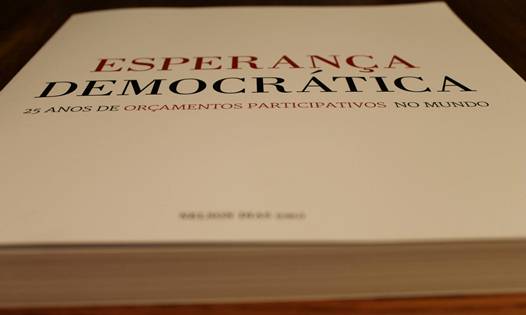
  • During the Conference of the International Observatory on Participatory Democracy (IODP), the latest book organized by Nelson Dias was launched. Entitled “Democratic Hope: 25 Years of Participatory Budgeting”, the book brings together texts by more than 40 authors from all the continents, providing an encompassing view of 25 years of PB around the world. I was happy to co-author one of the pieces with Rafael Sampaio. The subject of our article? Technology and participation, of course. The book is currently only available in Portuguese, but hopefully it will soon be translated into English.
  • Nelson Dias has also been doing some interesting research, looking at the development of Portuguese PBs over time and examining what makes some more sustainable than others. The actual impact of citizens’ input on the decision-making process emerges as the determining factor. When it comes to PB, it seems that merely consultative processes are like cigarettes: they stink and lead to early death.

New book organized by Nelson Dias, “Democratic Hope”.

On Brazil: 

  • If you take a closer look at the recent demonstrations in Brazil you will realize that some of the strongest demands refer to increased citizen participation. In Rio de Janeiro for instance, one of the demands is precisely the implementation of participatory budgeting. The Brazilian Federal Government seems to be willing to boost its support for PB.

Rio de Janeiro campaign for Participatory Budgeting.

  • Brazilian politicians start to recognize this demand for participation. And they are quickly realizing that, while they have remained analogue, society has moved on. This reflects well on an op ed by former President Lula in the NYT who argues that

(….) people do not simply wish to vote every four years. They want daily interaction with governments both local and national, and to take part in defining public policies, offering opinions on the decisions that affect them each day. In short, they want to be heard. This creates a tremendous challenge for political leaders. It requires better ways of engagement, via social media, in the workplace and on campuses, reinforcing interaction with workers groups and community leaders, but also with the so-called disorganized sectors, whose desires and needs should be no less respected for lack of organization.

  • Another article by the Mayor of Rio de Janeiro in the Huffington Post makes a similar point, highlighting some interesting numbers about the protests in Brazil:

During the recent demonstrations in Brazil, approximately 62 percent of the people were informed of the event via Facebook, a much higher rate than TV, which was first source of information to 14 percent of attendees, according to Ibope Institute. Three out of four agitators used social networks to round up support.

  • Even if most governments lag behind, there are some promising experiences. For instance, at the height of the demonstrations, Tarso Genro, the Governor of Rio Grande do Sul held a Google Hangout with citizens to listen to their demands. The number of participants: half a million.

Google hangout with 500,000 citizens.

  • Governor Genro then launched an online ideation/ranking process on political reforms.  182,000 votes were cast on over 200 proposals. Among the 10 proposals receiving the most votes? Increased citizen participation in decision-making processes.

Pair-wise voting system used on political reform consultation.

  • The Brazilian Institute of Applied Economics in Brazil (IPEA) is doing some interesting research looking at participation in some of the major federal programs in the country. One of the findings debunks the assumption that participatory processes may delay execution. Participatory and non-participatory processes perform equally when it comes to execution. The difference? Participatory processes are more innovative. More on that later.
  • The vitality of the use of social media to foster collective action in Brazil is contrasted by the demands of some segments of society to put an end to the proportional system of representation in the country. This seems, to a certain extent, rather contradictory. And here’s why.
  • Ronaldo Lemos is now officially representing the MIT Media-Lab in Brazil. This is great news. With an amazing track record, Ronaldo is also one of the people behind the Brazilian Internet “Bill of Rights”, the Marco Civil. Fruit of a truly collaborative exercise, the legislation aims to guarantee the civil rights of Internet users in Brazil.
  • While in the US some transparency advocates fear that Snowden’s leaks might have a chilling effect on the transparency agenda, in Brazil the results are somewhat different. The revelation of the NSA’s electronic surveillance of Brazilian officials has led President Dilma Roussef to consider the approval of the Marco Civil by Congress as a top priority for her Government. If approved, the legislation will be a milestone for those in the country working with technology and open government.

***

Crowdsourcing Off-Road Traffic Legislation in Finland

Screen Shot 2013-07-21 at 10.37.34 AM

A paper by Tanja Aitamurto (Tampere) and Hélène Landemore (Stanford) on an interesting crowdsourcing exercise in Finland.

Abstract

This paper reports on a pioneering case study of a legislative process open to the direct online participation of the public. The empirical context of the study is a crowdsourced off-road traffic law in Finland. On the basis of our analysis of the user content generated to date and a series of interviews with key participants, we argue that the process qualifies as a promising case of deliberation on a mass-scale. This case study will make an important contribution to the understanding of online methods for participatory and deliberative democracy. The preliminary findings indicate that there is deliberation in the crowdsourcing process, which occurs organically (to a certain degree) among the participants, despite the lack of incentives for it. Second, the findings strongly indicate that there is a strong educative element in crowdsourced lawmaking process, as the participants share information and learn from each other. The peer-learning aspect could be made even stronger through the addition of design elements in the process and on the crowdsourcing software.

The first two things that come to mind when reading this, are:

  1. If there is a “strong educative element” in the crowdsourcing process, we have an argument for large-scale citizen participation. The more citizens take part in a process, the more citizens benefit from the educative element.
  2. If we consider point 1 to be true, there is still a major technical challenge in terms of having appropriate platforms to enable large-scale deliberative processes. For instance, I have some reservations about crowdsourcing efforts that use ideation systems like Ideascale (as is the case for this experience). In my opinion such systems are prone to information cascades and a series of other biases that compromise an exercise in terms of a) deliberative quality and b) final outcomes (i.e. quality of ideas).

There’s still lots to learn on that front, and there is a dire need for more research of this type. Kudos should also go to the proponents of the initiative, who involved the authors in the project from the start.

Read the full paper here [PDF].

Does transparency lead to trust? Some evidence on the subject.

As open government gains traction in the international agenda, it is increasingly common to come across statements that assume a causal relationship in which transparency leads to trust in government. But to what extent are claims that transparency leads to trust backed up by evidence?

Judging from some recent publications on the subject, such a relationship is not as straightforward as sadvocates would like. In fact, in a number of cases, the evidence points in another direction: that is, transparency may ultimately decrease trust.

Below is a brief overview of research that has been carried out on the subject:

Transparency has been trumpeted by many as the key to trust in government. The assumption is that if government organisations open up and show the public what decisions are made, how they are made and what the results are, people will automatically have more trust in government. But does transparency really lead to more trust? Or will it only provide critical citizens with more information to blame government again and again for small mistakes? Transparency and Trustexamines the effects of transparency on trust in a government organisation. By using an experimental method this study moves beyond normative or correlational research on transparency. In doing so, causal inferences regarding the relation between transparency and trust are allowed. Several objects of transparency and dimensions of information are being put to the test in three experiments. The experiments show that transparency is merely a ‘hygiene factor’: it does not contribute to higher levels of trust and it can even lead to lower levels of trust if people are disappointed with the degree to which government is transparent. This conclusion challenges current overly optimistic assumptions concerning the effect of transparency on trust.

Building on the notion of transparency as a strong democratic value and theories of procedural justice, this article reports an explorative experimental test whether transparency in decision making may lead to increased perceived legitimacy in terms of decision acceptance and trust. This is done in a context of difficult decisions of high importance for citizens – namely priority setting in public health care. An experiment was designed in which ordinary citizens were presented with a description of a case of priority setting between two groups with different health care needs. One group was given no information at all on the decision-making procedure, as an example of non-transparent decision making, and six groups were presented with different descriptions of the decision-making procedure, as examples of transparency in decision making. The transparent procedures were derived from three basic forms of democratic decision making: representation, direct participation and expert decision making. A second manipulation framed the decision-making procedure alternatively in positive or negative terms in order to capture media framing effects as well. According to the findings of the study, transparent decision-making procedures tend to weaken rather than strengthen general trust in health care – a finding that might reveal obstacles to attempts to strengthen the legitimacy of health care by employing transparent procedures. The results also show that while the form of decision making had no significant impact on perceived legitimacy, positive or negative framing of a decision-making procedure influences public perceptions of both the procedure and the decision outcome.

Of course, the impact of transparency on trust may vary according to the context:

 Transparency is considered a key value for trustworthy governments. However, the effect of transparency on citizens’ trust across national cultures is overlooked in current research. This article compares the effect of transparency on trust in government in the Netherlands and South Korea. The effect is investigated in two similar series of three experiments. The authors hypothesize that the effect of transparency differs because the countries have different cultural values regarding power distance and short- and long-term orientation. Results reveal similar patterns in both countries: transparency has a subdued and sometimes negative effect on trust in government. However, the negative effect in South Korea is much stronger. The difference in the magnitude of transparency’s effect suggests that national cultural values play a significant role in how people perceive and appreciate government transparency.

But some evidence goes even further, suggesting that transparency may have a demobilizing effect on citizens. And, if context matters, such a demobilizing effect might be particularly strong in the context of developing countries:

International organizations, policy experts, and nongovernmental organizations promote greater governmental transparency as a crucial reform to enhance accountability and curb corruption. Transparency is predicted to deter corruption in part by expanding the possibilities for public or societal accountability, that is, for citizens and citizens associations to monitor, scrutinize, and act to hold public office holders to account. Although the societal accountability mechanism linking transparency and good government is often implied, it builds on a number of assumptions seldom examined empirically. This article unpacks the assumptions of principal-agent theories of accountability and suggests that the logic of collective action can be used to understand why exposure of egregious and endemic corruption may instead demobilize the demos (i.e., resignation) rather than enhance accountability (i.e., indignation). We explore these theoretical contentions and examine how transparency affects three indicators of indignations versus resignation—institutional trust, political involvement, and political interest—given different levels of corruption. The empirical analyses confirm that an increase in transparency in highly corrupt countries tends to breed resignation rather than indignation.

Democratic theory often assumes that offering more information to voters will enhance electoral accountability. However, it is unclear whether corruption information translates into higher political participation and increased support for challengers. For example, information on corruption could lower the utility one gets from participating in elections at all. We provide experimental evidence that such information not only decreases incumbent support in local elections in Mexico, but also decreases voter turnout and challengers’ votes, as well as erodes partisan attachments. Our results suggest that while information clearly is necessary to improve accountability, corruption information is not necessarily suficient, since voters may respond to it by withdrawing from the political process.

Surely, transparency remains an essential – although quite insufficient – ingredient of accountability. On the trust issue, one could easily think of a number of scenarios in which it is actually better that citizens do not trust their governments. In fact, systems of checks and balances and oversight institutions are not specifically conceived under the logic of trust. Quite on the contrary, such institutional designs assume some level of suspicion vis-à-vis governments: as put in the Federalist Paper No. 51, “If angels were to govern men, neither external nor internal controls on government would be necessary.”

Granted, in some cases a perfect world in which citizens trust their governments may well be desirable. It may even be that transparency leads – in the long run – to increased trust: a great way to sell transparency to governments. But if we want to walk the talk of evidence-based policymaking, we may consider dropping the trust rhetoric. At least for now.

Open Government, Feedback Loops, and Semantic Extravaganza

Tom Steinberg recently brought up one of the most important issues for those working at the intersection of technology and governance. It refers to the deficit/surplus of words to describe the “field” (I call it field in the absence of a better word) :

(…) what primary movement or sector is mySociety part of? Or Avaaz? Or Kiva? Or Wikileaks? When I ask myself these questions, no obvious words or names race quickly or clearly to mind. There is a gap – or at best quite a bit of fuzziness – where the labels should go.

This lack of good labels should surprise us because these groups definitely have aims and goals, normally explicit. Also, it is unusual because social and political movements tend to be quite good at developing names and sticking to them.

I personally have witnessed the creation of a number of names, including e-democracy, e-participation, e-governance, government 2.0, and open government. While some may argue that these names are different among themselves, no real consensus exists about what differentiates them. The common denominator is some fuzzy notion that technology may promote more democratic and/or efficient forms of government.

But why the absence of stable terms and the profusion of neologisms? And what are the implications?

The appeal to novelty (argumentum ad novitatem), which asserts that something is superior because of its newness, seems to be one of the reasons behind the constant reinvention of terms. Indeed, adhering to such a logical fallacy might be particularly tempting for the technology community, where new solutions tend to be an improvement over older ones. On top of that, some technological millennialism does not hurt. After all, a constant of humankind is our inclination to think we are living unique moments. Coming up with new names partially fulfils our natural desire to belong to a special moment in history.

But coming up with new terms also allows for “semantic plasticity”, which enables those who use the terms to expand and contract their meanings according to their needs. Take the example of the term “open government data” and its ambiguous meanings: sometimes it is about accountability, sometimes it is about service delivery, other times it is both. Such ambiguity, some might claim, is opportunistic. It creates a larger consumer base that does not only include governments interested in openness as a democratic good, but also less democratically inclined governments who may enjoy the label of “openness” by publishing data that have little to do with accountability. Malleable terms attract larger audiences.

Moreover, new terms (or assigning new meanings to existing ones) also provides additional market entry-points. While it may take 10,000 hours of deliberate practice to become an expert at something, it only takes a few tweets to qualify as a new Gov 2.0 “guru”, an open government “thinker”.

But Tom Steinberg hits the nail on the head when describing why the profusion of names and their terminological inconsistency is problematic:

And this worries me because consistent names help causes to persist over time. If the field of AIDS research had been renamed every 6 months, could it have lasted as it did? Flighty, narrowly used language confuses supporters, prevents focus and is generally the enemy of long term success.

Indeed, the lack of terminological consistency in the field is a major obstacle to cumulative learning. And  worse, this problem goes beyond the name for “the field” as a whole, also affecting practices that are part of that very field.

As an illustration, recently some people from the development/opengov worlds have started to unrestrainedly employ the term “feedback loop”. While the understanding around the term (in its latest usage) is imprecise, it normally alludes to an idea of citizen engagement followed by some kind of responsiveness. If there is a reason for the use of the term “feedback loop” in the context of citizen engagement, no serious effort has been made to explain what it is. A term is thus assigned a new meaning to describe things that have been largely studied by others under different names.

I myself haven’t resisted and have used the term a couple of times, but this is not free from implications. For instance, Nathaniel Heller, is a prominent and astute voice in the international Open Government space. Recently, Nathaniel wrote a blog post asking “Is There a Case Against Citizen Feedback Loops”. To date, his post goes unanswered. But had he asked for instance about “the case against (or for) citizen engagement”, I believe a productive conversation could have ensued, based on a couple of thousands of years of knowledge on the matter. But the language defines the audience, and the use of terms like feedback loops reduces the odds of engaging in a  conversation with those who hold relevant expertise.

The major problem with this semantic extravaganza relates to the extent to which it blocks  the connection with existing knowledge. As new terms come up, the “field” starts, again, to be considered as a new one.  And the fact that the majority is unaware of evidence that may exist under other terminology leads to a collective illusion that the evidence does not exist. Then, the “we know very little” sentence starts to be repeated ad nauseam, opening the floodgates to all kinds of half-baked hypotheses (usually masked as “theory of change”) and unbridled calls for “evidence”.

Questions that have been asked in the past, and that have been answered either entirely or partially, re-emerge as if they were new ones. The process of answering these new questions starts again from zero. With neologisms, so dear to those working in “the field”, comes what they claim to despise the most: the re-invention of the wheel.

And these calls for “evidence” are undermined by their very lack of terminological and conceptual consistency – and disinterest in existing knowledge. To further complicate things, researchers and scholars who could potentially debunk the novelty myth may lack incentives to do so, as with the novelty narrative comes the prospect for increased visibility and funding.

But an immediate way out of such a situation seems unlikely. An embargo on the creation of new terms – or assigning new meanings to existing ones – would be neither enforceable nor productive, let alone democratic. Maybe the same would be true for attempting to establish a broad convention around a common vocabulary. But recognition by those working in the field that the individual incentives for such a terminological carnival may be offset by the collective benefits of a more consistent and accurate vocabulary would be a first step.

In the meantime, a minimal willingness to connect with existing knowledge would help a lot, to say the least.

Italian Politics 2.0: The Multifaceted Effect of the Internet on Political Participation

We investigate the impact of the diffusion of high-speed Internet on different forms of political participation, using data from Italy. We exploit differences in the availability of ADSL broadband technology across municipalities, using the exogenous variation induced by the fact that the cost of providing ADSL-based Internet services in a given municipality depends on its relative position in the pre-existing voice telecommunications infrastructure. We first show that broadband Internet had a substantial negative effect on turnout in parliamentary elections between 1996 and 2008. However, we also find that it was positively associated with other forms of political participation, both online and offline: the emergence of local online grassroots protest movements, and turnout in national referenda (largely opposed by mainstream parties). We then show that the negative effect of Internet on turnout in parliamentary elections is essentially reversed after 2008, when the local grassroots movements coalesce into the Five-Star Movement (M5S) electoral list. Our findings are consistent with the view that: 1) The effect of Internet availability on political participation changes across different forms of engagement; 2) It also changes over time, as new political actors emerge who can take advantage of the new technology to tap into the existence of a disenchanted or demobilized contingent of voters; and 3) These new forms of mobilization eventually feed back into the mainstream electoral process, converting “exit” back into “voice”.

Read full paper here [PDF].

Mobile Connectivity in Africa: Increasing the Likelihood of Violence?

Regarding the above picture of DRC government troops with their mobile phones, Alexis Madrigal from the Atlatinc wrote in his column last year:

I don’t know what to say about this photograph aside from suggesting that an enterprising PhD student write a dissertation on “Cell Phones in War.” How are fighting, killing, and controlling territory different when you can call your brother after battle, post a photo of your squadron on the march to Facebook, or play Angry Birds between skirmishes?

Part of the answer to Alexis’ question comes in a newly published article in the American Political Science Review by postdoctoral fellow Jan Pierskalla and PhD candidate Florian Hollenbach (ht the Monkey Cage).

In a nutshell, the authors’ findings suggest that cell phone coverage in Africa increases the likelihood of political violence. The abstract is below:

The spread of cell phone technology across Africa has transforming effects on the economic and political sphere of the continent. In this paper, we investigate the impact of cell phone technology on violent collective action. We contend that the availability of cell phones as a communication technology allows political groups to overcome collective action problems more easily and improve in-group cooperation, and coordination. Utilizing novel, spatially disaggregated data on cell phone coverage and the location of organized violent events in Africa, we are able to show that the availability of cell phone coverage significantly and substantially increases the probability of violent conflict. Our findings hold across numerous different model specifications and robustness checks, including cross-sectional models, instrumental variable techniques, and panel data methods.

It will be interesting to see how this paper resonates with different audiences, such as the ICT4D community and political scientists. Some have already started to question the methodology and underlying assumptions in the paper.

But despite the findings of this study, like it or not, at some point technology cheerleaders will have to come to terms with a simple fact: if technology helps us overcome problems of collective action, there’s no reason to believe that this can only happen when it comes to virtuous collective action. And it shouldn’t take a PhD to know that.

Read the full paper here [PDF].

How effective are whistleblower laws in combating corruption?

A new discussion paper by Rajeev Goel and Michael Nelson looks at the effectiveness of US whistleblower laws in combating corruption. The abstract is below:

Whistleblower laws are becoming important governance tools in both the public and private sectors. To examine the effectiveness of whistleblower laws and their awareness, this study creates a unique internet-based measure of awareness about whistleblower laws and provisions, focusing on the United States. Placing the analysis within the larger corruption literature, our results show that greater whistleblower awareness results in more observed corruption and this holds across specifications. Internet awareness of whistleblower laws appears to be more effective at exposing corruption than the quantity and quality of whistleblower laws themselves.

And a few excerpts from the conclusion, which highlights the role of the internet:

Couching the empirical analysis within the extant literature on the causes of corruption, our results show that greater internet awareness about whistleblower laws results in more corruption coming to light and being successfully prosecuted. In terms of magnitude, an increase in whistleblower hits by one sample standard deviation would increase average corruption convictions per million population by nearly thirty over a decade-long period. Interestingly, the internet awareness about corruption seems relatively more effective at exposing corruption than the quantity and quality of whistleblower laws themselves. Further, the direct government resources allocated to controlling crime and the indirect efforts via whistleblower awareness are found to be complementary. These findings are generally robust to alternate specifications, including an allowance for potential endogeneity of whistleblower awareness, and to broader measures of internet whistleblower awareness. (…)

The results for the United States in terms of the effectiveness of whistleblower laws in exposing corruption should be of interest to policy makers everywhere, especially in other nations that do not have adequate protections for whistleblowers. As internet diffusion grows and the digital divide narrows, it would be interesting to see a further impact of whistleblower awareness and, more generally, of the internet.

Read the full paper here [PDF].

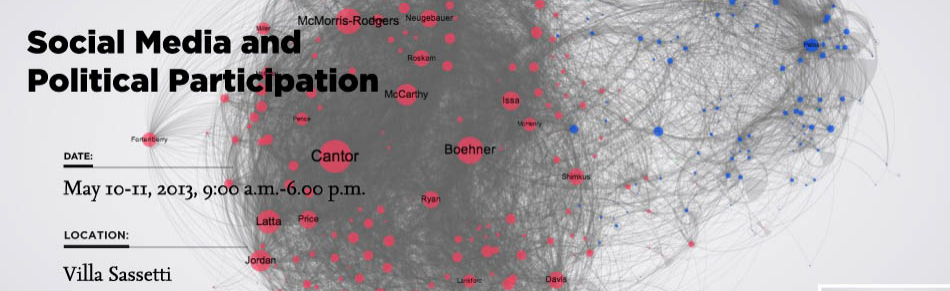
12 Papers on Social Media and Political Participation

Screen Shot 2013-05-27 at 21.47.06

I just came across the website of the Social Media and Political Participation conference, which took place in Florence this May.

Below is the presentation by Henry Farrel (from the Monkey Cage) on Cognitive Democracy and the Internet, followed by links to the papers.

http://vimeo.com/66820855

Cognitive Democracy and the Internet Henry Farrell, George Washington University

Politics 2.0: The Multifaceted Effect of Broadband Internet on Political Participation Francesco Sobbrio, European University Institute

Birds of the Same Feather Tweet Together: Bayesian Ideal Point Estimation Using Twitter Data Pablo Barbera, New York University

Politicians Go Social. Estimating Intra-Party Heterogeneity (and its Effects) through the Analysis of Social Media Andrea Ceron, University of Milan

Connective Action in European Mass Protest  Eva Anduiza, Autonomous University of Barcelona

The Bridges and Brokers of Global Campaigns in the Context of Social Media Sandra Gonzalez-Bailon, Oxford Internet Institute

Every Tweet Counts? How Sentiment Analysis of Social Media Can Improve our Knowledge of Citizens’ Policy Preferences: An Application to Italy and France Stefano Iacus, University of Milan

The Rise and Decline of the “Occupy Wall Street” Movement from a Digital Perspective Alessandro Flammini, University of Indiana

Is the Internet Good or Bad for Politics? Yes. Let’s talk about How and Why Zeynep Tufekci, University of North Carolina, Chapel Hill

Follow the leader! Dynamics and Patterns of Activity among the Followers of the Main Italian Political Leaders during the 2013 General Election Campaign Cristian Vaccari, New York University and University of Bologna

Social Networks, Peer Pressure and Protest Participation Alexey Makarin, New Economic School, Moscow

Mobilizing Online Data to Understand Offline Mobilization: Two Attempts at Online Observational Research in Russia   Sam Greene, King’s College London

The Potential of Twitter Data for Surveillance of Epidemics in Brazil

A while ago in Brazil I had the pleasure of meeting the folks from Federal University of Minas Gerais who are using twitter data to monitor disease (more specifically dengue) epidemics. Their work is awesome, and worth taking note of.
The website of the project is herehttp://www.observatorio.inweb.org.br/dengue/destaques/

And here’s a paper that provides a more detailed account of the experience:

*Dengue surveillance based on a computational model of spatio-temporal locality of Twitter∗

Gomide et al. (2011)

Twitter is a unique social media channel, in the sense that users discuss and talk about the most diverse topics, in- cluding their health conditions. In this paper we analyze how Dengue epidemic is reflected on Twitter and to what extent that information can be used for the sake of surveillance. Dengue is a mosquito-borne infectious disease that is a leading cause of illness and death in tropical and sub- tropical regions, including Brazil. We propose an active surveillance methodology that is based on four dimensions: volume, location, time and public perception. First we ex- plore the public perception dimension by performing sentiment analysis. This analysis enables us to filter out con- tent that is not relevant for the sake of Dengue surveillance. Then, we verify the high correlation between the number of cases reported by official statistics and the number of tweets posted during the same time period (i.e., R2 = 0.9578). A clustering approach was used in order to exploit the spatio- temporal dimension, and the quality of the clusters obtained becomes evident when they are compared to official data (i.e., RandIndex = 0.8914). As an application, we propose a Dengue surveillance system that shows the evolution of the dengue situation reported in tweets.

Download paper (pdf) at http://journal.webscience.org/429/1/92_paper.pdf