
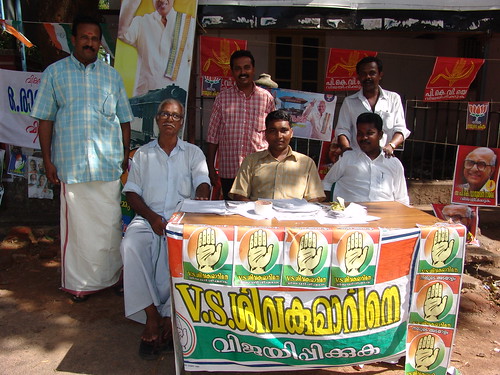
Picture by neotint on flickr.
(I am working on a brief literature review on the benefits of participation, focusing on its different types of impact. Most of it (but not entirely) relates to participatory budgeting. Below are a few of the sections covered and a rough draft. Ideas and suggestions for topic coverage and literature (preferably peer-reviewed) are more than welcome.)
INCREASED TAX REVENUE / REDUCTION OF TAX DELINQUENCY
As shown in a cross-national analysis by Torgler & Schneider (2009), citizens are more willing to pay taxes when they perceive that their preferences are properly taken into account by public institutions. Along these lines, the existing evidence suggests the existence of a causal relationship between citizen participation processes and levels of tax compliance. For instance, studies show that Swiss cantons with higher levels of democratic participation present lower tax evasion rates, even when controlling for other factors. This effect is particularly strong when it comes to direct citizen participation in budgetary decisions, i.e. fiscal referendum (Frey & Feld 2002, Frey et al. 2004, Torgler 2005). In the Latin American context, a number of authors have observed a similar relationship with regard to participatory budgeting processes. In the municipality of Porto Alegre (BR) for instance, Schneider and Baquero (2006) show that the adoption of PB led to a substantive increase in tax revenues. In a similar vein, a comparative study of 25 municipalities in Latin America and Europe finds a significant reduction in levels of tax delinquency after the adoption of PB (Cabannes 2004: 36). In another study Zamboni (2007) compares the performance of similar Brazilian municipalities with and without PB processes: even when controlling for other factors, the study finds a significant relationship between the existence of PB and the reduction of tax evasion.
Some evidence suggests that participation may be even more effective at curbing tax evasion than traditional deterrence measures, such as fines and controls. At odds with conventional economic reasoning, the literature in the field of “tax morale” suggests that citizen participation actually comes across as a better remedy for tax evasion than commonly adopted deterrence policies (e.g. Torgler 2005, Feld & Frey 2007, Feld & Torgler 2007) .
INCREASED EFFICIENCY / BETTER ALLOCATION OF RESOURCES
According to a study by the Institute of Development Studies (IDS) on the PB process in Rio Grande do Sul state, “PB has promoted a redistributive development model while improving budgetary planning and efficiency” (Schneider & Goldfrank 2002, p. iii). From an efficiency point of view, the study observes that the PB process improved governmental capacity to allocate funds across governmental divisions (e.g. secretariats) to enact planned projects. For instance, with the implementation of PB, the rate of completion of budgeted education projects increased from an average of 62.5% to 82.5% (Schneider & Goldfrank 2002) . The implementation of PB also increased the planning capacity of the state, leading to a budget that better forecast the revenue receipts, with the government actually spending amounts systematically closer to the planned expenses (Schneider & Goldfrank 2002).
Another study on the municipality of Porto Alegre shows that prior to the implementation of the PB process, no more than two percent of the municipal budget was dedicated to investment, with most of the budget allocated to personnel expenses. Five years later, the combination of increased tax revenues and efficiency gains – engendered by the PB process – led to a tenfold increase in the percentage of investments (Baiocchi 2003). Finally, as shown by Zamboni’s (2007) quantitative study, even when controlling for other factors, municipalities that adopt PB processes are better managed and present less financial irregularities (e.g. corruption) than those without PB.
The elements highlighted above lead to another question regarding the extent to which citizen engagement leads to more targeted and evidence-based allocation of resources. The literature dealing with citizen participation primarily approaches this issue by considering the extent to which participatory processes lead to an inversion of priorities and to increased social justice. In this respect, the available evidence suggests that participatory budgeting leads to significant shifts in priorities and policies, towards expenditures that directly benefit poor sections of society (Avritzer 1999, Navarro 2001, Blore et al. 2004). In a similar vein, quantitative analysis by Baiocchi et al. (2006) finds that participatory budgeting is strongly associated with a reduction in extreme poverty and increased access to basic services. More recently, a World Bank report demonstrated that participatory budgeting bears a statistically significant impact on a number of social indicators. Amongst others, the authors of the report find that PB is positively and strongly associated with improvements in poverty rates and water services (World Bank 2008).
INCREASED TRUST AND IMPROVED IMPLEMENTATION PROCESSES
The relationship between participatory budgeting and increased trust and legitimacy draws from a well-established body of literature dealing with issues of citizen participation, social capital and trust in government. It is widely known that citizen engagement leads to increased levels of trust in institutions: this holds true even when controlling for other factors (Brehm & Rahn 1997, Keele 2007, Tampubolon 2010) . Indeed, in some cases, one of the strongest effects of participatory processes is precisely that of increased trust in institutions (Altschuller & Corrales 2009).
The understanding that PB reduces implementation hurdles draws both from broader literature dealing with policy implementation and from the specific experience of PB itself. In a more general perspective, the evidence from experimental settings suggests that decisions made democratically lead to better cooperative models, mitigating problems of free-riding and facilitating subsequent policy implementation (Ertan et al. 2009, Dal Bó et al. 2010). Beyond experiments in controlled environments, the case for increased participation in decision-making processes – as a means to reduce implementation drawbacks – has been made in fields as diverse as those of economic reforms (Frieden 1991), agriculture policies (Bardhan 2000) and workplace decisions (Black & Lynch 2001). For PB the evidence is by no means different: as the outcome of an inclusive decision-making process, the implementation of PB decisions has been documented as less subject to elite capture and clientelist exchanges (Wampler 2001). The literature has also demonstrated the substantive popular support enjoyed by public works and services selected through the PB process, with local communities often collaborating with supplementary personnel, financial and material resources in order to increase the resources available for the implementation of PB projects (Cabannes 2004).
REFERENCES:
Altschuller, D., Corrales, J. (2009) “The Spillover Effects of Participation in Development Projects: Evidence from Honduras and Guatemala.” Working paper, CCEUP.
Avritzer, L. (1999) “Public Deliberation at the Local Level: Participatory Budgeting in Brazil.” Paper delivered at the Experiments for Deliberative Democracy Conference, Wisconsin January, 2000
Baiocchi, G. (2003) “Radicals in Power: The Workers Party and Experiments in Urban Democracy in Brazil.” London: Zed.
Baiocchi, G.; Heller, P.; Chaudhuri, S. and Kunrath Silva, M. (2006) “Evaluating Empowerment: Participatory Budgeting in Brazilian Municipalities”, in R. Alsop, M. Frost Bertelsen and J. Holland (eds), Empowerment in Practice: From Analysis to Implementation, Washington: World Bank
Bardhan, P. (2000) “Irrigation and Cooperation: An Empirical Analysis of 48 Irrigation Communities in South India.” Economic Development and Cultural Change, 48(4): 847–65.
Black, S., M. Lynch (2001) “How to Compete: The Impact of Workplace Practices and Information Technology on Productivity.” Review of Economics and Statistics, 83(3): 434–45.
Blore, I., Devas, N. and Staler (2004) “Municipalities and Finance: a sourcebook for Capacity Building.” Earthscan, London.
Brehm J, Rahn W. (1997) “Individual-level evidence for the causes and consequences of social capital.” American Journal of Political Science. Vol.41:999- 1023.
Cabannes, Y (2004) “Participatory budgeting: a significant contribution to participatory democracy”. Environment and Urbanization 16(1): 27-46
Dal Bó, P., A. Foster, and L. Putterman (2010) “Institutions and Behavior: Experimental Evidence on the Effects of Democracy” American Economic Review 100: 2205–2229
Ertan A., Talbot P., and L. Putterman (2009) “Who to Punish? Individual Decisions and Majority Rule in Mitigating the Free Rider Problem.” European Economic Review, 53(5): 495–511.
Feld, L. and Torgler, B. (2007) “Tax Morale After the Reunification of Germany: Results from a Quasi-Natural Experiment.” CESifo Working Paper No. 1921.
Feld, L.P., and B.S. Frey (2007) “Tax Compliance as the Result of a Psychological Tax Contract: The Role of Incentives and Responsive Regulation”, Law and Policy 29: 102–20.
Frieden, Jeffry (1991) “Debt, Development, and Democracy: Modern Political Economy and Latin America, 1965-1985.” Princeton, NJ: Princeton University Press.
Frey, Bruno S., Matthias Benz, and Alois Stutzer (2004) “Introducing Procedural Utility: Not Only What, but Also How Matters.” Journal of Institutional and Theoretical Economics, 160(3): 377–401.
Frey, Bruno S., and Lars P. Feld (2002) “Deterrence and Morale in Taxation: An Empirical Analysis.” CESifo Working Paper no. 760, August 2002.
Gaventa, J. & Barret, G. (2010) “So what difference does it make? Mapping the outcomes of citizen engagement”. IDS Working Paper, 347, 1-74.
Goldfrank, Benjamin (2006) “Lessons from Latin American Experience in Participatory Budgeting.” Paper presented at the Latin American Studies Association Meeting. San Juan, Puerto Rico, March 2006.
Keele,L. (2007) “Social Capital and the Dynamics of Trust in Government”,American Journal of Political Science,Vol.51,No.2:241-257.
Navarro, Z. (2001) “Decentralization, Participation and Social Control of Public Resources: “Participatory Budgeting” In Porto Alegre (Brazil).” Development, 41(3), 68–71
Schneider, A. and B. Goldfrank. (2002) ‘Budgets and ballots in Brazil: participatory budgeting from the city to the state’, IDS Working Paper 149. Brighton: IDS.
Schneider, A. and M. Baquero (2006) “Get What You Want, Give What You Can: Embedded Public Finance in Porto Alegre.” Brighton: Institute of Development Studies.
Tampubolon, G. (2010) “Civic engagement and trust in Britain 2003-2004.” ISC Working Paper 2010-14, Manchester University.
Torgler, B. (2005) “Tax morale and Direct Democracy.” European Journal of Political Economy 21, pp. 525 – 531.
Torgler, B. and F. Schneider (2009) “The impact of tax morale and institutional quality on the shadow economy.” Journal of Economic Psychology, 30(2). pp. 228-245.
Varma, K. N., & Doob, A. N. (1998) “Deterring economic crimes: the case of tax evasion”. Canadian Journal of Criminology, 40, 165–184.
Wampler, B (2004) “Expanding Accountability Through Participatory Institutions: Mayors, Citizens, and Budgeting in Three Brazilian Municipalities,” Latin AmericanPolitics & Society, 46:2.
World Bank Report (2008). “Brazil: toward a more inclusive and effective participatory budget in Porto Alegre.” Report No. 40144-BR.
Zamboni, Yves. 2007. “Participatory Budgeting and Local Governance: An evidence based evaluation of participatory budgeting experiences in Brazil.” Working Paper, Bristol University.

 DemocracySpot