Can Informed Public Deliberation Overcome Clientelism? Experimental Evidence from Benin

picture by geezaweezer on flickr

Brilliant paper by Leonard Wantchekon

This paper provides experimental evidence on the effect of “informed” town hall meetings on electoral support for programmatic, non-clientelist platforms. The experiment takes place in Benin and involves real candidates running in the first round of the 2006 presidential elections. The treatment is a campaign strategy based exclusively on town hall meetings during which policy proposals made by candidates are “specific” and informed by empirical research. The control is the “standard” strategy based on campaign rallies followed by targeted or clientelist electoral promises. We find that the treatment has a positive effect on self-perceived knowledge about policies and candidates. The data also suggests a positive effect of the treatment on turnout and electoral support for the candidates participating in the experiment. The results suggest that new democracies may contain electoral clientelism by institutionalizing the use of both town hall meetings in electoral campaigns and policy expertise in the design of electoral platforms.

Read the full paper here [PDF]

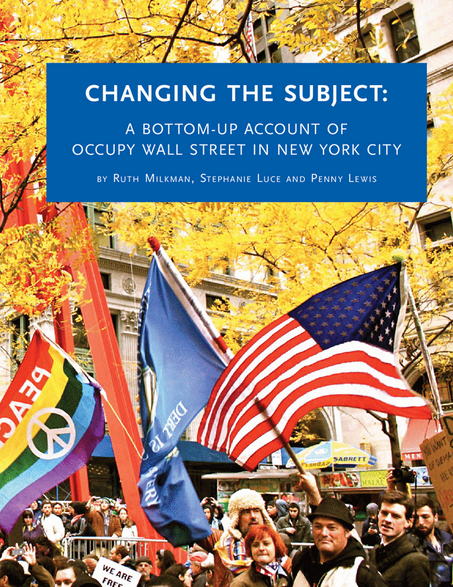
A Bottom-up Account of Occupy Wall Street

New report on Occupy Wall Street in New York City.

Screen Shot 2013-01-29 at 08.46.39

Some of the findings:

  • Highly educated young adults were overrepresented
    among OWS activists and supporters, a group with
    limited ethnic/racial or class diversity
  • Most OWS activists and supporters were deeply
    skeptical of the mainstream political system as an
    effective vehicle for social change. For some, this
    skepticism intensified after the election of Barack
    Obama in 2008 failed to produce the changes they
    had been led to expect.
  • Despite being disillusioned with mainstream
    politics, many OWS activists and supporters
    remain politically active and civically engaged.
  • OWS was able to attract supporters with a wide
    variety of specific concerns, many of whom had
    not worked together before, This was in large part
    because it made no formal “demands,” and united
    around the “We Are the 99%” slogan.

Read the full report here.

(HT Archon Fung)

Democratic Innovation in Open Government

The Oregon Citizen’s Initiative Review is without doubt one of the most interesting recent innovations in the field of citizen engagement.

Here’s an excerpt from Participedia on the initiative:

The Oregon Citizen Initiative Review (Oregon CIR) is a Citizens’ Initiative Review designed to allow citizens of the U.S. state of Oregon to evaluate statewide ballot initiatives. A Citizens’ Initiative Review (CIR) is a Citizens’ Jury that deliberates about a ballot initiative. The Oregon CIR is intended to give voters clear, useful, and trustworthy evaluations of initiatives on the ballot. (…)

The Oregon CIR involves four categories of participants: panelists, the citizens who deliberate about a ballot initiative; advocates, individuals who are knowledgeable about the ballot initiative and who argue in support of or in opposition to the ballot initiative; stakeholders, individuals who will be affected by the ballot initiative, who also argue in support of or in opposition to the ballot initiative; and background witnesses, individuals who are knowledgeable about issues related to the initiative, and who present neutral background information about those issues to the panelists. (…)

I have written before about different methods of participant selection, and this is one of the strong points of this initiative:

To select the panelists for the 2010 Oregon CIRs, HDO used the following selection process: HDO took a probability sample of 10,000 Oregon voters. All voters in this sample were sent an invitation to participate in the 2010 Oregon CIR and a demographic survey. Three hundred fifty members of the sample responded, for a response rate of 3.5%. From those who responded, HDO, using the demographic data from the sample survey, anonymously chose 24 panelists, and 5 alternate panelists, for each 2010 Oregon CIR. The panelists and alternates for each CIR were chosen using stratification, so that each panel closely matched the Oregon population in terms of place of residence, political partisanship, education, ethnicity/race, gender, and age.

If advocates and policymakers in the open government space are really serious about citizen engagement, this is the sort of institutional innovation they should be looking at. Unfortunately, this doesn’t seem to be happening.

Find out more about it at http://healthydemocracy.org/

My Reading Suggestions (Part One)

Fundação Biblioteca Nacional

Tom Steinberg asked me for a list of my favorite recent reads. So here’s the first part of a rather disorganized list of readings and other resources, with sporadic comments on why I like some of them. The list is heterogeneous in terms of subject, method and quality. In my opinion, the common denominator among the different resources is their relevance for those working at the intersection of participation and technology.

ON COLLECTIVE INTELLIGENCE

There is definitely a lot of bad reading out there about collective intelligence.   Indeed, many of the discussions and papers out there are nothing more than half-baked re-readings of ideas and concepts well established in the field of epistemic democracy. But there are a few exceptions. Acquainting myself with Hélène’s awesome work in the domain was one of the highlights for me in 2012. Here’s a sample:

Landemore, Hélène E., Democratic Reason: The Mechanisms of Collective Intelligence in Politics (April 1, 2011). COLLECTIVE WISDOM: PRINCIPLES AND MECHANISMS, Hélène Landemore and Jon Elster, eds., Cambridge University Press, Spring 2012.

You can find more of Hélène’s work here http://www.helenelandemore.com/.

Also, if you are interested in high-level talks and discussions about collective intelligence, the videos of conferences below are some of the best things out there:

Collective Intelligence Conference (Video)

College de France – Collective Intelligence (Video) 

Epistemic Democracy Conference (Video) 

ON COLLECTIVE ACTION

Miller, J & Page, S 2004, ‘The Standing Ovation Problem’, COMPLEXITY, vol. 9, no. 5, pp. 8-16.

Bond, R. M., C. J. Fariss, J. J. Jones, A. D. I. Kramer, C. Marlow, J. E. Settle, and J. H. Fowler.  2012. “A 61-Million-Person Experiment in Social Influence and Political Mobilization.”  Nature 489: 295–298.

S. Gonzalez-Bailon, J. Borge-Holthoefer, A. Rivero, and Y. Moreno. The Dynamics of Protest Recruitment through an Online Network. Nature, December 2011.

Margetts, Helen Zerlina, John, Peter, Reissfelder, Stephane and Hale, Scott A., Social Influence and Collective Action: An Experiment Investigating the Effects of Visibility and Social Information Moderated by Personality (April 18, 2012).  

Hale, Scott A. and Margetts, Helen Zerlina, Understanding the Mechanics of Online Collective Action Using ‘Big Data’ (March 22, 2012).

ON DELIBERATION

David Lazer is the co-author of two of these papers. If you don’t know it already, Stuart Shulman’s work is definitely worth checking out. Thamy Pogrebinschi is probably one of the people to look out for in the coming years in the field of participatory democracy.

Lazer, David, Sokhey, Anand E., Neblo, Michael A. and Esterling, Kevin M., Deliberative Ripples: The Network Effects of Political Events (August 10, 2010).

Neblo, Michael A., Esterling, Kevin M., Kennedy, Ryan, Lazer, David and Sokhey, Anand E., Who Wants to Deliberate – and Why? (September 15, 2009). HKS Working Paper No. RWP09-027.

Stuart W. Shulman, 2009. “The case against mass e–mails: Perverse incentives and low quality public participation in U.S. federal rulemaking,” Policy & Internet, volume 1, number 1, article 2.

Pogrebinschi, Thamy, The Squared Circle of Participatory Democracy: Scaling-up Deliberation to the National Level (2012). APSA 2012 Annual Meeting Paper. 

THE ROI OF CITIZEN ENGAGEMENT:

Largely unknown even among the most enthusiastic participation advocates, there is a growing body of literature in the field of tax morale that links citizen engagement to reduced tax evasion: one of the best cases for the ROI of Open Government.  Below is one of the best papers in the field.

Frey, Bruno S., and Lars P. Feld (2002) “Deterrence and Morale in Taxation: An Empirical Analysis.” CESifo Working Paper no. 760, August 2002

You can find more references about tax morale here. Alex Howard gives a good account of how this might be happening in the DR Congo, helped by mobile phones (a project I’m part of).

And if the subject is the ROI of open government, here’s a paper that links participatory budgeting to reduced infant mortality (and there’s more to be published on that front soon).

RANDOMIZED CONTROLLED TRIALS AND OPEN GOVERNMENT

If I were to make any predictions for 2013, I would say we will start to see a growing number of studies using randomized controlled trials (RCTs) to assess the validity of claims for transparency and participation. Indeed, some donors in the open government space have already started to ask for RCT evaluations as a project component. Here are a couple of examples of how good studies on the subject would look (IMHO):

Olken, B. 2010. Direct Democracy and Local Public Goods: Evidence from a Field Experiment in Indonesia. American Political Science Review, 104, pp 243-267

Zhang, K. 2012. “Increasing Citizen Demand for Good Government in Kenya”. Stanford University. 

Of course, scholars, practitioners and donors should take claims about the awesomeness of RCTs with a good grain of salt (and pepper):

Deaton, A. 2008. Instruments of development? Randomization in the tropics, and the hunt for the keys to development. Princeton University mimeo.

Cartwright, N. 2007. “Are RCTs the gold standard?” Biosocieties, 2, 11–20.

FUN STUFF ON TURNOUT AND ELECTIONS

Rothschild, David and Justin Wolfers. 2011. “Forecasting Elections: Voter Intentions versus Expectations.” Working paper, University of Pennsylvania.

Gomez, Brad T., Thomas G. Hansford, and George A. Krause. 2007. “The Republicans Should Pray for Rain: Weather, Turnout, and Voting in U.S. Presidential Elections.” Journal of Politics 69 (August): 649–63.

This is just the first part of a longer list. I hope to finish a second part soon, focusing – among other things – on the (uneasy) intersection of behavioural economics and participatory democracy.

Happy reading.

13 New Articles on Participatory Budgeting

A band inaugurates a public work selected through participatory budgeting in Brazil (picture by Prefeitura de Olinda on Flickr).

The new issue of the Journal of Public Deliberation (Volume 8, Issue 2 – 2012) presents 13 new articles on participatory budgeting. Edited by Janette Hartz-Karpz (Curtin University) and Brian Wampler (Boise State University) “This special issue of the Journal of Public Deliberation brings together leading scholars expand our conceptual tools to understand why PB programs are being adopted, how governments are adapting the rules and principles to meet different policy and political goals, and the impact of PB on civil society, state reform, and social well-being.”

Below links to the articles:

Transnational Models of Citizen Participation: The Case of Participatory Budgeting
Yves Sintomer, Carsten Herzberg, Anja Röcke, and Giovanni Allegretti

Institute for Local Government’s Public Engagement Program

https://i0.wp.com/www.ca-ilg.org/sites/main/files/pe_block_2_0.jpg


The Institute for Local Government’s Public Engagement program offers resources and support to help local officials and their communities design and carry out effective and inclusive public engagement activities. Topics include:

Public Engagement Basics

Broadening Participation

Difficult Situations in Public Engagement

Public Engagement Topic Areas

Measuring Success

Online Public Engagement & Technology

Sustaining Public Engagement

Myths and realities about effective civil society participation, transparency and accountability

picture by Video Volunteers(VV) on flickr

picture by Video Volunteers(VV) on flickr

By María González de Asis  & Barak D. Hoffman

Participatory development is a growing focus of donor development policies. Over the past decade, the World Bank alone has allocated approximately $75 billion for these types of initiatives (Mansuri and Rao 2011) and other development partners are also allocating large sums of money in this area. Interest in participatory development derives in part from understanding that poor development outcomes often result from bad governance and lack of citizen empowerment. Participatory development seeks to remedy these weaknesses by having people take an active role in community development and by creating demand for good governance (DFGG). The World Bank defines DFGG as the capacity of “citizens to hold the state accountable and make it responsive to their needs” (World Bank 2011: 3). Participatory development seeks to reduce poverty directly through engaging citizens in the design and implementation of development projects, and indirectly through encouraging improved governance at the national and local level.A large body of research exists on the outcomes of participatory development projects. Their impact is mixed. In general, programs appear more successful at developing citizen awareness and empowerment than at influencing development outcomes, either directly or indirectly. At the same time, we are gaining a better idea of what works and what does not, and how to design more effective strategies. This paper provides an overview of the theory, practice, and outcome of donor efforts to support participatory development.

Read the full paper here [PDF].

On Political Efficacy and Occupy Wall Street’s Postage Paid Protest

One of the strongest predictors of participation is what political scientists call “political efficacy”. Broadly speaking, one of the components of political efficacy refers to an individual’s perception of his/her impact through his/her political actions. In other words, all other things equal, the greater your perception that your actions are likely to have an impact, the greater your political efficacy. And the greater this sense of efficacy, the more likely you are to engage. Furthermore, political scientists often refer to the generation of a virtuous cycle in which participation leads to more participation.

A while ago, through a post on techPresident by Micah Sifry I came across this brilliant story about an alternative form of protest in the context of the Occupy Wall Street movement. Below is an excerpt from Micah’s article that summarizes the idea put forward by Artie Moffa, a “part–time poet and SAT tutor”:

“His idea,which he described in a short YouTube video that has had more than 400,000views in just six days, steals a page from both Saul Alinsky and Abbie Hoffman.You know all those credit card solicitations banks send you all the time, he asks, sitting at his couch in a shirt and striped tie. Take the business reply envelope and stuff it with a message back to the bank, or if you’re feeling like it, add a wood shim or something firm to add to the cost of the return mail. “Every hour banks spend responding to us is an hour banks don’t spend lobbying Congress figuring out how to screw us,” he notes. “If you can’t occupy Wall Street, you can at least keep Wall Street occupied.”

The post includes an interesting and entertaining interview with Moffa. Both the story and the interview present two interesting (although anecdotal) illustrations of how political efficacy can operate.

The first one refers to the action in itself. My hunch is that the reasonable popularity of the idea is a result of the fact that it generates an immediate sense of political efficacy. Although one can question how efficient the practice may be in terms of furthering the causes of the movement, by sending back the envelope individuals know that their action will have a tangible impact: the return mail will have to be paid for by the sender of the correspondence. Making a rough – and maybe unfair – comparison, by sending back the mail with a message or a wood shim inside the envelope gives citizens a stronger – or more immediate – sense of political efficacy than signing an online petition.

The second element corresponds to the virtuous cycle, in which participation, resulting in increased political efficacy, will lead to even more participation. As Artie Moffa puts it it:

“About a month ago, I wrote a letter to the editors of The Economist, teasing them about a bad layout decision they made with the cover for their “Hunting the Rich”issue (Sep 24). I couldn’t believe they printed my letter. I guess that experience itched the bug bite. I wanted to say a little more.”

That bug bite, that made Artie want to say more, was political efficacy.

The Benefits of Citizen Engagement: a (Brief) Review of the Evidence

Picture by neotint on flickr.

(I am working on a brief literature review on the benefits of participation, focusing on its different types of impact. Most of it (but not entirely) relates to participatory budgeting. Below are a few of the sections covered and a rough draft. Ideas and suggestions for topic coverage and literature (preferably peer-reviewed) are more than welcome.)

INCREASED TAX REVENUE / REDUCTION OF TAX DELINQUENCY

As shown in a cross-national analysis by Torgler & Schneider (2009), citizens are more willing to pay taxes when they perceive that their preferences are properly taken into account by public institutions. Along these lines, the existing evidence suggests the existence of a causal relationship between citizen participation processes and levels of tax compliance. For instance, studies show that Swiss cantons with higher levels of democratic participation present lower tax evasion rates, even when controlling for other factors. This effect is particularly strong when it comes to direct citizen participation in budgetary decisions, i.e. fiscal referendum (Frey & Feld 2002, Frey et al. 2004, Torgler 2005). In the Latin American context, a number of authors have observed a similar relationship with regard to participatory budgeting processes. In the municipality of Porto Alegre (BR) for instance, Schneider and Baquero (2006) show that the adoption of PB led to a substantive increase in tax revenues. In a similar vein, a comparative study of 25 municipalities in Latin America and Europe finds a significant reduction in levels of tax delinquency after the adoption of PB (Cabannes 2004: 36). In another study Zamboni (2007) compares the performance of similar Brazilian municipalities with and without PB processes: even when controlling for other factors, the study finds a significant relationship between the existence of PB and the reduction of tax evasion.

Some evidence suggests that participation may be even more effective at curbing tax evasion than traditional deterrence measures, such as fines and controls. At odds with conventional economic reasoning, the literature in the field of “tax morale” suggests that citizen participation actually comes across as a better remedy for tax evasion than commonly adopted deterrence policies (e.g. Torgler 2005, Feld & Frey 2007, Feld & Torgler 2007) .

INCREASED EFFICIENCY / BETTER ALLOCATION OF RESOURCES

According to a study by the Institute of Development Studies (IDS) on the PB process in Rio Grande do Sul state, “PB has promoted a redistributive development model while improving budgetary planning and efficiency” (Schneider & Goldfrank 2002, p. iii). From an efficiency point of view, the study observes that the PB process improved governmental capacity to allocate funds across governmental divisions (e.g. secretariats) to enact planned projects. For instance, with the implementation of PB, the rate of completion of budgeted education projects increased from an average of 62.5% to 82.5% (Schneider & Goldfrank 2002) . The implementation of PB also increased the planning capacity of the state, leading to a budget that better forecast the revenue receipts, with the government actually spending amounts systematically closer to the planned expenses (Schneider & Goldfrank 2002).

Another study on the municipality of Porto Alegre shows that prior to the implementation of the PB process, no more than two percent of the municipal budget was dedicated to investment, with most of the budget allocated to personnel expenses. Five years later, the combination of increased tax revenues and efficiency gains – engendered by the PB process – led to a tenfold increase in the percentage of investments (Baiocchi 2003). Finally, as shown by Zamboni’s (2007) quantitative study, even when controlling for other factors, municipalities that adopt PB processes are better managed and present less financial irregularities (e.g. corruption) than those without PB.

The elements highlighted above lead to another question regarding the extent to which citizen engagement leads to more targeted and evidence-based allocation of resources. The literature dealing with citizen participation primarily approaches this issue by considering the extent to which participatory processes lead to an inversion of priorities and to increased social justice. In this respect, the available evidence suggests that participatory budgeting leads to significant shifts in priorities and policies, towards expenditures that directly benefit poor sections of society (Avritzer 1999, Navarro 2001, Blore et al. 2004). In a similar vein, quantitative analysis by Baiocchi et al. (2006) finds that participatory budgeting is strongly associated with a reduction in extreme poverty and increased access to basic services. More recently, a World Bank report demonstrated that participatory budgeting bears a statistically significant impact on a number of social indicators. Amongst others, the authors of the report find that PB is positively and strongly associated with improvements in poverty rates and water services (World Bank 2008).

INCREASED TRUST AND IMPROVED IMPLEMENTATION PROCESSES

The relationship between participatory budgeting and increased trust and legitimacy draws from a well-established body of literature dealing with issues of citizen participation, social capital and trust in government. It is widely known that citizen engagement leads to increased levels of trust in institutions: this holds true even when controlling for other factors (Brehm & Rahn 1997, Keele 2007, Tampubolon 2010) . Indeed, in some cases, one of the strongest effects of participatory processes is precisely that of increased trust in institutions (Altschuller & Corrales 2009).

The understanding that PB reduces implementation hurdles draws both from broader literature dealing with policy implementation and from the specific experience of PB itself. In a more general perspective, the evidence from experimental settings suggests that decisions made democratically lead to better cooperative models, mitigating problems of free-riding and facilitating subsequent policy implementation (Ertan et al. 2009, Dal Bó et al. 2010). Beyond experiments in controlled environments, the case for increased participation in decision-making processes – as a means to reduce implementation drawbacks – has been made in fields as diverse as those of economic reforms (Frieden 1991), agriculture policies (Bardhan 2000) and workplace decisions (Black & Lynch 2001). For PB the evidence is by no means different: as the outcome of an inclusive decision-making process, the implementation of PB decisions has been documented as less subject to elite capture and clientelist exchanges (Wampler 2001). The literature has also demonstrated the substantive popular support enjoyed by public works and services selected through the PB process, with local communities often collaborating with supplementary personnel, financial and material resources in order to increase the resources available for the implementation of PB projects (Cabannes 2004).

REFERENCES:
Altschuller, D., Corrales, J. (2009) “The Spillover Effects of Participation in Development Projects: Evidence from Honduras and Guatemala.” Working paper, CCEUP.

Avritzer, L. (1999) “Public Deliberation at the Local Level: Participatory Budgeting in Brazil.” Paper delivered at the Experiments for Deliberative Democracy Conference, Wisconsin January, 2000

Baiocchi, G. (2003) “Radicals in Power: The Workers Party and Experiments in Urban Democracy in Brazil.” London: Zed.

Baiocchi, G.; Heller, P.; Chaudhuri, S. and Kunrath Silva, M. (2006) “Evaluating Empowerment: Participatory Budgeting in Brazilian Municipalities”, in R. Alsop, M. Frost Bertelsen and J. Holland (eds), Empowerment in Practice: From Analysis to Implementation, Washington: World Bank

Bardhan, P. (2000) “Irrigation and Cooperation: An Empirical Analysis of 48 Irrigation Communities in South India.” Economic Development and Cultural Change, 48(4): 847–65.

Black, S., M. Lynch (2001) “How to Compete: The Impact of Workplace Practices and Information Technology on Productivity.” Review of Economics and Statistics, 83(3): 434–45.

Blore, I., Devas, N. and Staler (2004) “Municipalities and Finance: a sourcebook for Capacity Building.” Earthscan, London.

Brehm J, Rahn W. (1997) “Individual-level evidence for the causes and consequences of social capital.” American Journal of Political Science. Vol.41:999- 1023.

Cabannes, Y (2004) “Participatory budgeting: a significant contribution to participatory democracy”. Environment and Urbanization 16(1): 27-46

Dal Bó, P., A. Foster, and L. Putterman (2010) “Institutions and Behavior: Experimental Evidence on the Effects of Democracy” American Economic Review 100: 2205–2229

Ertan A., Talbot P., and L. Putterman (2009) “Who to Punish? Individual Decisions and Majority Rule in Mitigating the Free Rider Problem.” European Economic Review, 53(5): 495–511.

Feld, L. and Torgler, B. (2007) “Tax Morale After the Reunification of Germany: Results from a Quasi-Natural Experiment.” CESifo Working Paper No. 1921.

Feld, L.P., and B.S. Frey (2007) “Tax Compliance as the Result of a Psychological Tax Contract: The Role of Incentives and Responsive Regulation”, Law and Policy 29: 102–20.

Frieden, Jeffry (1991) “Debt, Development, and Democracy: Modern Political Economy and Latin America, 1965-1985.” Princeton, NJ: Princeton University Press.

Frey, Bruno S., Matthias Benz, and Alois Stutzer (2004) “Introducing Procedural Utility: Not Only What, but Also How Matters.” Journal of Institutional and Theoretical Economics, 160(3): 377–401.

Frey, Bruno S., and Lars P. Feld (2002) “Deterrence and Morale in Taxation: An Empirical Analysis.” CESifo Working Paper no. 760, August 2002.

Gaventa, J. & Barret, G. (2010) “So what difference does it make? Mapping the outcomes of citizen engagement”. IDS Working Paper, 347, 1-74.

Goldfrank, Benjamin (2006) “Lessons from Latin American Experience in Participatory Budgeting.” Paper presented at the Latin American Studies Association Meeting. San Juan, Puerto Rico, March 2006.

Keele,L. (2007) “Social Capital and the Dynamics of Trust in Government”,American Journal of Political Science,Vol.51,No.2:241-257.

Navarro, Z. (2001) “Decentralization, Participation and Social Control of Public Resources: “Participatory Budgeting” In Porto Alegre (Brazil).” Development, 41(3), 68–71

Schneider, A. and B. Goldfrank. (2002) ‘Budgets and ballots in Brazil: participatory budgeting from the city to the state’, IDS Working Paper 149. Brighton: IDS.

Schneider, A. and M. Baquero (2006) “Get What You Want, Give What You Can: Embedded Public Finance in Porto Alegre.” Brighton: Institute of Development Studies.

Tampubolon, G. (2010) “Civic engagement and trust in Britain 2003-2004.” ISC Working Paper 2010-14, Manchester University.

Torgler, B. (2005) “Tax morale and Direct Democracy.” European Journal of Political Economy 21, pp. 525 – 531.

Torgler, B. and F. Schneider (2009) “The impact of tax morale and institutional quality on the shadow economy.” Journal of Economic Psychology, 30(2). pp. 228-245.

Varma, K. N., & Doob, A. N. (1998) “Deterring economic crimes: the case of tax evasion”. Canadian Journal of Criminology, 40, 165–184.

Wampler, B (2004) “Expanding Accountability Through Participatory Institutions: Mayors, Citizens, and Budgeting in Three Brazilian Municipalities,” Latin AmericanPolitics & Society, 46:2.

World Bank Report (2008). “Brazil: toward a more inclusive and effective participatory budget in Porto Alegre.” Report No. 40144-BR.

Zamboni, Yves. 2007. “Participatory Budgeting and Local Governance: An evidence based evaluation of participatory budgeting experiences in Brazil.” Working Paper, Bristol University.

Voice and Choice by Delegation

Food for thought for the advocates of liquid democracy.

In many Western countries, options for citizens to influence public services are increased to improve the quality of services and democratize decision making. Possibilities to influence are often cast into Albert Hirschman’s taxonomy of exit (choice), voice, and loyalty. In this article we identify delegation as an important addition to this framework. Delegation gives individuals the chance to practice exit/ choice or voice without all the hard work that is usually involved in these options. Empirical research shows that not many people use their individual options of exit  and voice, which could lead to inequality between users and nonusers. We identify  delegation as a possible solution to this problem, using Dutch health care as a case
study to explore this option. Notwithstanding various advantages, we show that voice and choice by delegation also entail problems of inequality and representativeness.

For those who are willing to read more than quotes and blog posts, the full paper is here [PDF].